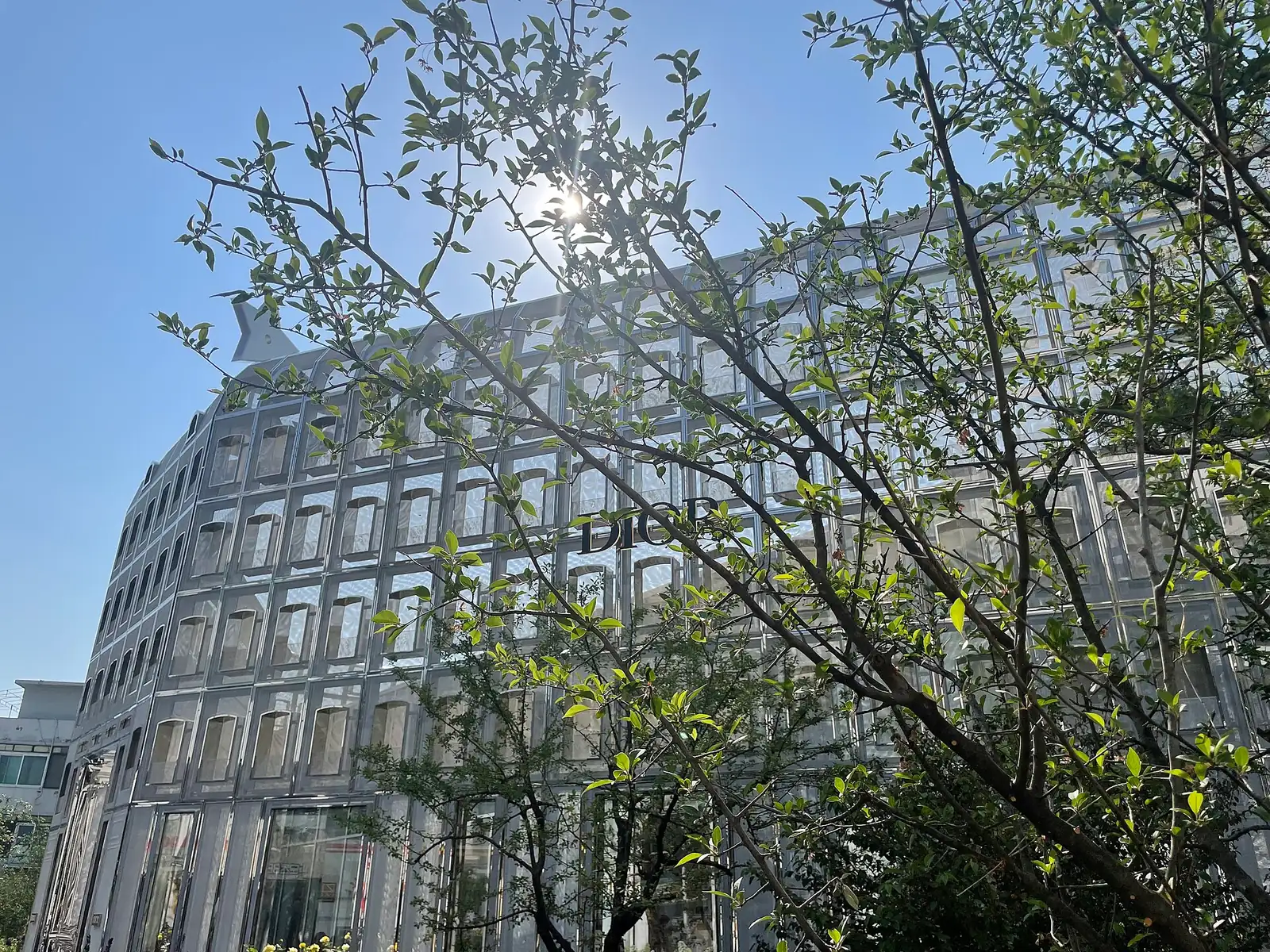
Seoul's 'Brooklyn' has a Cafe Street, and cafes come third there
If you have read about Seongsu in English, you have probably met it as "Seoul's answer to Brooklyn", the phrase Time Out used in 2024 when its ranking of neighborhoods around the world put Seongsu-dong 4th. On its commercial-district map, Seoul's city government has given one back-street block in Seongsu 2-ga 1-dong (a dong is a city neighborhood unit) an official name: Seongsu-dong Cafe Street (성수동카페거리). With a name like that, you would expect cafes to be the most common shop. The block used to be shoe factories and warehouses, and Seongdong District says the Yeonmujang-gil area, once a factory zone, has turned into cafes and cultural spaces.
But count the shops and the answer does not match the name. So which type of shop is the most common on this block?
Source: Seoul Commercial District Analysis Service (stores by commercial zone) · Time Out The 38 coolest neighbourhoods in the world right now — No. 4, Seongsu-dong (2024 list)
The most common shop is clothing — 86 stores, with cafes third at 51
604 shops — Shops in the Seongsu-dong Cafe Street zone. No. 1 is clothing at 86 — 35 more than cafes (51)
A year earlier (Q2 2025)
Seoul's commercial-district service counted every shop in this block in the second quarter of 2026 and sorted them by type. Clothing stores, which the city files as 일반의류 (general clothing), come first with 86, and Korean restaurants come second with 64. Cafes, filed as 커피-음료 (coffee and drinks), are third with 51. For every cafe you walk past on this block, you pass about 1.7 clothing stores. The name Cafe Street rings a little hollow.
In the past year clothing stores grew by 9 and cafes by 4. Cafes are growing too, but clothing is growing faster.
Source: Seoul Commercial District Analysis Service (stores by commercial zone)
Why clothing?
47% — Share of this zone's sales that came from clothing stores — Q2 2026. More than five times the Seoul-wide average
Because the people who come here buy clothes. Seoul estimates sales for this block from card-payment data, and in the second quarter of 2026, 47% of those sales came from clothing stores. That is more than five times the average for all of Seoul's commercial areas. Despite the name Cafe Street, clothing sales were 17 times cafe sales.
The brand-side numbers point the same way. In an analysis by the property consultancy CBRE Korea, reported by the Korean business paper Money Today, each of the three brands compared sold more at its Seongsu store than at its Gangnam-area store.
Source: Seoul Commercial District Analysis Service (estimated sales by commercial zone) · Money Today "I make more money here than in Gangnam" … Seongsu, beyond a hot spot, becomes a "core commercial district" (in Korean; cites a CBRE Korea analysis) — Result produced with Seoul Metropolitan Government public data (서울특별시 공공데이터)
Since when have the crowds been coming?
4.4× — People getting off at Seongsu Station between noon and 6 p.m. — September 2015 → September 2026. The number getting off at 8 a.m. has not changed
September 2015
Since 2022. The number of people getting on and off at Seongsu Station in September stayed flat through 2021, then began to climb, and by 2026 it was 2.3 times the 2015 level.
The extra people are not commuters. The number getting off at 8 a.m. is unchanged, while the number getting off between noon and 6 p.m. has grown 4.4 times.
Several things came together that year. In May, Dior opened a concept store in Seongsu, and in September the fashion platform Musinsa moved its headquarters from Apgujeong-dong to Seongsu. Musinsa's stated reason was that fashion-brand showrooms and pop-up stores had been multiplying around Seoul Forest. The head of Seongdong District has also said, in essence, that companies moved in once people began to gather.
Source: Seoul subway boardings and alightings by line, station and hour · Economist (Korean weekly, economist.co.kr) Article on the opening of the Dior Seongsu concept store (in Korean) · Financial News Article on Musinsa moving its headquarters to Seongsu-dong (in Korean) · Herald Economy (헤럴드경제), U.S. edition (heraldk.com) Article on the Seongdong District head's New Year address (in Korean) — Result produced with Seoul Metropolitan Government public data (서울특별시 공공데이터)
Why Seongsu in particular?
86% — Share of Seongdong District's shoe and leather makers located in Seongsu's four dongs — 2024. Shoemaking is still concentrated here
Seongsu was originally a neighborhood that made fashion goods. From the late 1950s, small factories pushed out by the Cheonggyecheon redevelopment moved here, and when Seoul redrew its land-use zones in 1964, the Ttukseom area became a semi-industrial zone. Even in 2024, 86% of Seongdong District's shoe and leather manufacturers were in Seongsu's four dongs.
The neighborhood that made things became the neighborhood that sells them. The number of fabric, clothing, shoe and leather retailers in Seongsu's four dongs doubled over the ten years from 2009.
Old factory and warehouse buildings became cafes and showrooms, and at first the rent was cheap too. When the Korea Real Estate Board first measured the Ttukseom commercial area in the first quarter of 2020, rents for small shops were 75% of the Seoul average. By the second quarter of 2026 that figure had risen to 123% of the Seoul average.
- Late 1950sSmall factories pushed out by the Cheonggyecheon redevelopment move to Seongsu
- 1964When land-use zones are redrawn, the Ttukseom area becomes a semi-industrial zone
- 1970sThe rice mill (now Daelim Warehouse) and chemical factory (now Seongsu Yeonbang) buildings go up
- 2005Seoul Forest opens on the Ttukseom site that held a golf course, horse-riding grounds and more
- 2022Dior concept store (May) · Musinsa headquarters move (September)
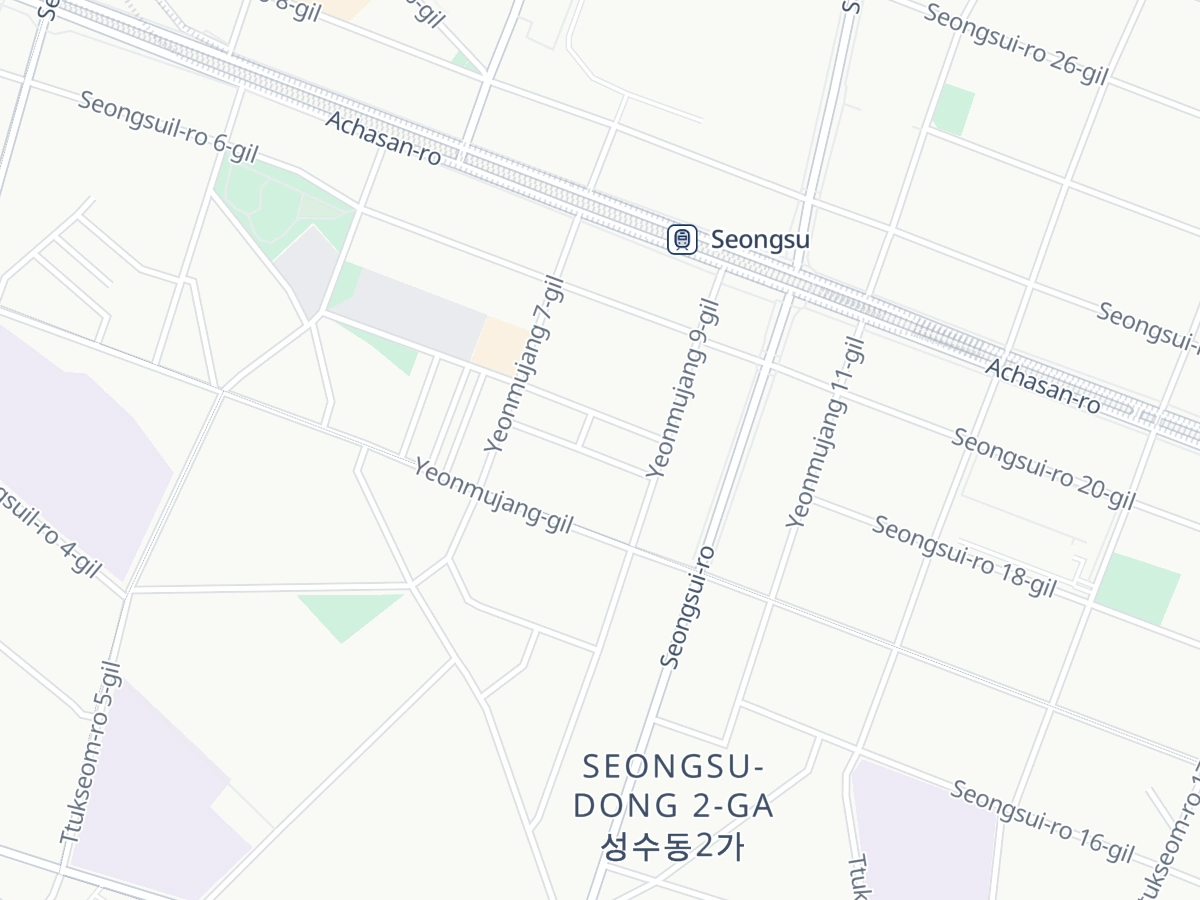
Map © OpenStreetMap contributors · Protomaps
- 1Daelim Warehouse Gallery — 1970s rice mill → cafe and gallery
- 2Seongsu Yeonbang — 1970s chemical factory → cultural complex
- 3Cafe Onion Seongsu — metal-parts factory → cafe
- 4Seongsu Yeonmujang-gil — old shoe-factory lane → boutiques and pop-ups
- 5DIOR Seongsu — Dior concept store, 2022
Source: Seoul Museum of History 2014 Seoul Living Culture Survey ⑫ Seongsu-dong: Artisans, a Thousand Hammer Blows (in Korean) · Seongdong District, Seoul Business Census (by detailed industry and dong, 2015–2024; in Korean) · Seongdong District, Seoul · held by the Statistics Library of Statistics Korea Seongdong District Business Census report (2009–2011; in Korean) · Korea Real Estate Board Commercial real-estate rent survey (small-shop rents, Ttukseom commercial area)
Fifth place is shoes, 29 stores — the old shoemaking trade is still here
Fourth place goes to Western restaurants with 31 shops, and fifth to shoes with 29. There is a history behind all those shoe stores.
Seoul's handmade-shoe trade began in 1925 with shoe repairers at Yeomcheongyo Bridge, in front of what was then Gyeongseong Station, and moved through Myeong-dong and Geumho-dong before settling in Seongsu. Seoul Tourism Organization says 70% of Korea's handmade-shoe makers are based here.
Joint sales shops for local shoemakers stand near Seongsu and Ttukseom stations, and the Hope Platform building offers shoemaking experiences. A made-to-measure pair is made after a consultation about the shape of your feet, and takes about one to two weeks.
Source: Seoul Commercial District Analysis Service (stores by commercial zone)
About 1 in 7 cafes is a franchise — in Myeong-dong it is 1 in 3
14.8% — Share of Seongsu's cafes that are franchises. Less than half of Myeong-dong (31.6%) or Yeoui-dong (32.6%)
Across Seongsu's four dongs, 14.8% of cafes are franchises. By the same measure Myeong-dong is at 31.6%, so Seongsu's share is less than half. Yeonnam-dong goes lower still, at 4.3%.
Source: Seoul Commercial District Analysis Service (stores by administrative dong)
When is the block less crowded?
46% — Morning (6–11 a.m.) street crowd as a share of 2–5 p.m.. Saturday is 83% of Friday, Sunday 73%
On this block, Seoul's living-population count, meaning the number of people who were in the area at that hour, is highest between 2 and 5 p.m. The morning, from 6 to 11 a.m., runs at 46% of that level. Fridays are the busiest day, and Sundays run at 73% of a Friday. If you want a quieter Seongsu, mornings and Sundays are the better bet.
Source: Seoul Commercial District Analysis Service (street-level population by commercial zone) — Result produced with Seoul Metropolitan Government public data (서울특별시 공공데이터)
Seongsu Station is busiest on Fridays
139,547 people — Average Friday boardings and alightings. The busiest day, Friday, and the quietest, Sunday, differ by 43,447 people a day
On an average Friday in September, about 140,000 people got on or off at Seongsu Station, against about 96,000 on an average Sunday. Unlike the street figures, the station does not empty out on Saturdays: Saturday was close to a weekday.
Transit-card taps, boarding plus alighting. One person who rides in and out counts twice.
Source: Seoul subway boardings and alightings by line and station
Foreign visitors peak at 4 p.m.
4,400 people — Short-stay foreigners in Seongsu's four dongs at 4 p.m. (September daily average). 3.4 times the quietest hour, 2 a.m. (1,305 people)
Short-stay foreigners in Seongsu are most numerous at 4 p.m.: on an average September day, 4,400 of them were in the area at that hour. Americans make up a larger share of short-stay foreigners here than in Myeong-dong (15.1% against 9.1%), and on the Seoul Forest side of Seongsu one in four is American.
The figure is the daily average of short-stay foreigners present in the dong at that hour, which is different from the number who visited that day. Seoul masks some small-country cells, so the shares by country were counted from the unmasked cells (99.0% of the total).
Source: [Short-stay foreigners] Seoul living population by administrative dong (250 m) — Result produced with Seoul Metropolitan Government public data (서울특별시 공공데이터)
What these numbers miss
Seoul counts only shops in its list of 100 everyday business types. Showrooms, pop-up stores and galleries are left out, so on the street you may see more clothing than the count shows. The boundary of Seongsu-dong Cafe Street is one the city drew in June 2023, so it may not match the cafe street on other maps, and the living-population figures include people who work or live here, not only travelers. Sales are estimates the city makes from card-payment data, and the survey method for the number of businesses changed in 2020, so we did not compare figures from before and after the change.
So, three reasons to go — depending on what you want
- If you are going for clothes, this is the block for it: nearly half of this block's sales are clothing, and for every cafe you pass about 1.7 clothing stores.
- If you want handmade shoes, the trade that began in 1925 is still here, but a made-to-measure pair takes one to two weeks, so order early in your trip.
- If you want a quiet walk, come in the morning or on a Sunday: the morning street count is 46% of the afternoon's.
Eight stops on foot in a day, 5.5 km
Walk eight of the places below in one direction, from the Seongsu Station end toward Seoul Forest, and it comes to about 5.5 km. A 23-second map video follows the route.
- Cafe Onion Seongsu
- Daelim Warehouse Gallery
- Seongsu Yeonmujang-gil
- DIOR Seongsu
- Seongsu-dong Galbi Alley
- Understand Avenue
- Seoul Forest
- Seongsu Pedestrian Overpass
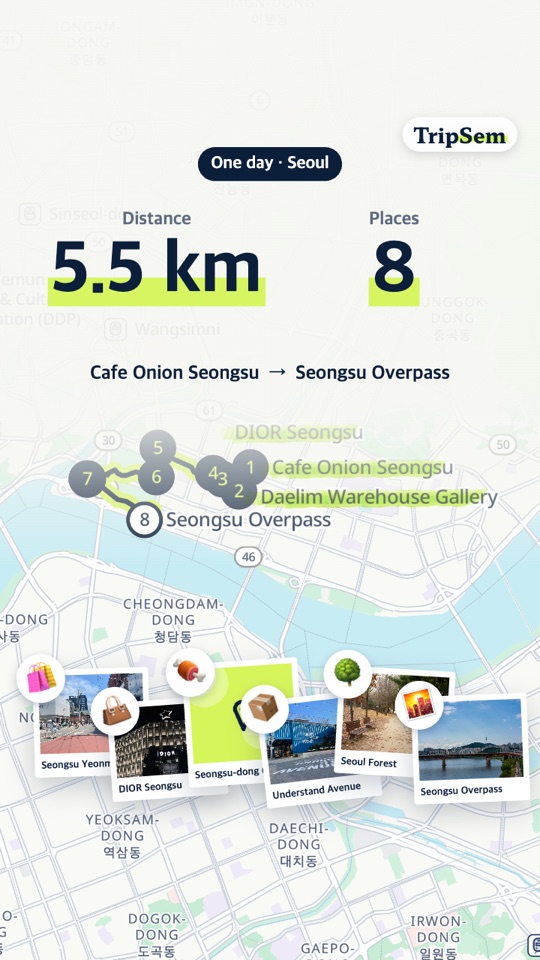
Getting there: the first three stops are around Seongsu Station (Line 2), the galbi alley is closest to Ttukseom Station (Line 2), and Understand Avenue, Seoul Forest and the overpass are reached from Seoul Forest Station (Suin-Bundang Line). Most place cards below say how to get there from the nearest station.
If this is your first trip to Korea, our eSIM calculator works out how much mobile data a day you will need.
The name still says Cafe Street, but counted shop by shop, this block is closer to a clothing street.
Places in Seongsu 17
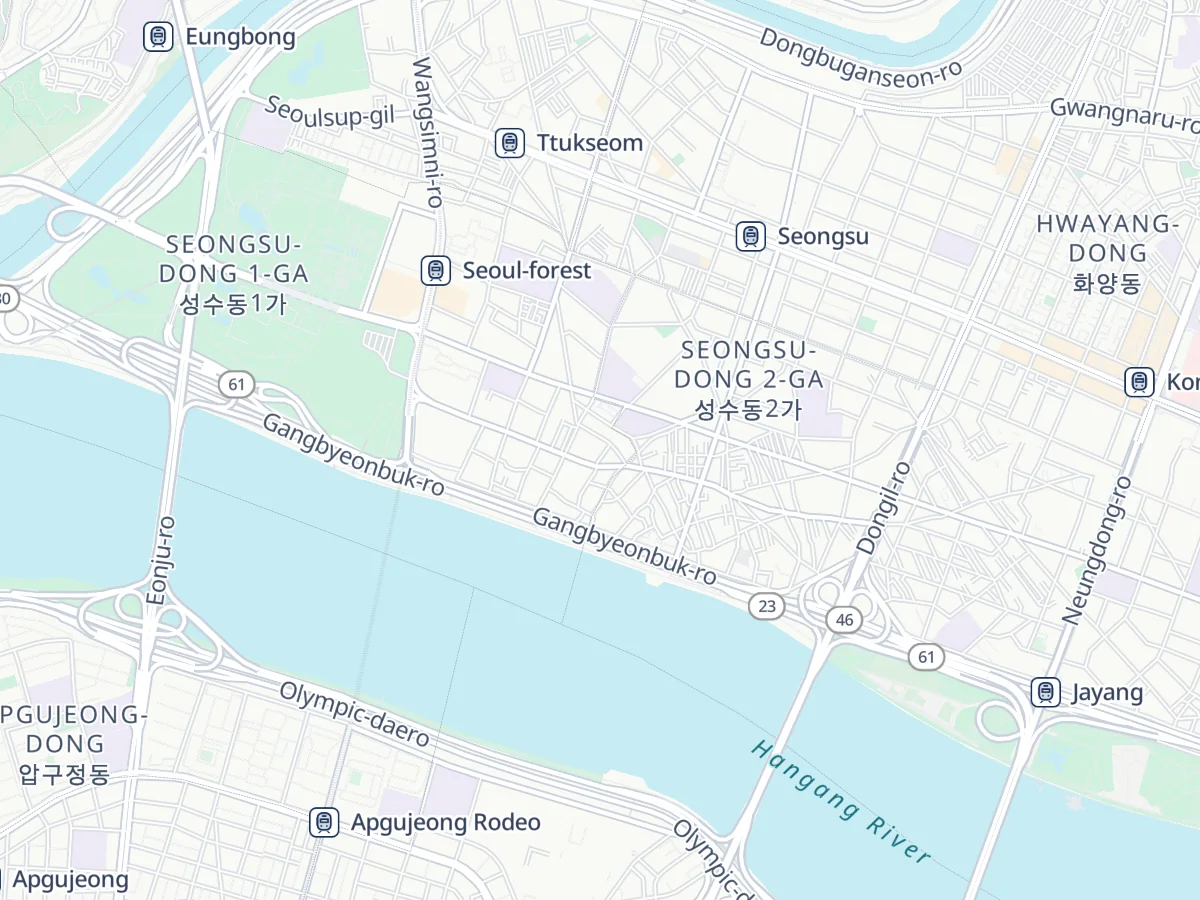
Map © OpenStreetMap contributors · Protomaps
This is an affiliate link: we may earn a commission if you book through it.
Hotels near SeongsuAffiliate-
Seoul Forest
An urban forest that opened on June 18, 2005 on Ttukseom, where the Han River and Jungnangcheon stream meet.
Getting thereSeoul Forest Station (Suin-Bundang Line), Exit 4, 2-minute walk
More details
It was once a king's hunting ground, Seoul's first water-source reservoir in 1908, and a racecourse and golf course, and it became a park through the funds and volunteer work of about 5,000 citizens.
Pets are allowed, but they must be on a leash of 2 m or less and are not to be taken onto lawns or garden areas. Tents, including shade tents, may not be set up.
HoursThe park is open at all times. The Ecological Forest (deer enclosure and pedestrian bridge) is open 05:30–21:30.
BookingNo reservation needed.
AdmissionFree
ParkingAvailable · 24 hours, small cars 200 won per 5 minutes · very limited space
Source: Seoul Parks — Parks of Seoul, Seoul Forest introduction · Photo Enigma7seven · CC BY-SA 3.0 · Checked Oct 5
-
Seongsu Yeonmujang-gil
A lane where cafes, boutiques and pop-up stores have moved one after another into an old shoe-factory alley.
Getting thereSeongsu Station (Line 2), Exit 3, 533 m (measured to Yeonmujang-gil 1)
More details
Seoul Tourism Organization says the name Yeonmujang comes from a place where Joseon-era soldiers practiced martial arts.
Pop-up stores are open only for short periods, so Seoul Tourism Organization advises you to be sure to check which pop-ups are open before you go.
HoursThe street can be walked 24 hours; shop hours vary by shop.
BookingNo reservation needed; it is a street you simply walk.
AdmissionFree
Source: Seoul Tourism Organization VisitSeoul — Seongsu Yeonmujang-gil · Photo Tjwlgns · CC BY 4.0 · Checked Oct 20
-
Seongsu-dong Cafe Street
A street formed when cafes and cultural spaces moved into the Yeonmujang-gil area, once a zone of factories and warehouses.
More details
One of the 11 stops on Seongdong District's "Seongsu Cafe" walking course is not a cafe but the headquarters of the Seoul Mounted Police, a new building completed in 2008.
The "Seongsu Cafe" walking course drawn up by Seongdong District links 11 stops, and adding the segment times in the course table gives 57 minutes of walking alone. The mural alley of the Handmade Shoes Street (Yeonmujang-gil 28-9) is also on this course.
HoursThe street is open 24 hours with no days off.
BookingA street you simply walk; no reservation needed.
AdmissionFree
ParkingNone — use the Seongsu Station public parking lot
Source: Seongdong-gu Culture & Tourism — Seongsu Cafe course · Photo Korea Tourism Organization · KOGL Type 1 · Checked Oct 20
-
Seongsu Handmade Shoes Street
A handmade-shoe street whose trade began in 1925 with shoe repairers at Yeomcheongyo Bridge in front of Gyeongseong Station and moved through Myeong-dong and Geumho-dong to Seongsu-dong.
Getting thereSeongsu Station (Line 2), Exit 1, 111 m · Hope Platform: 5-minute walk straight ahead from Ttukseom Station, Exit 4
More details
Seongdong District records that after liberation, shops opened at Yeomcheongyo selling dress shoes made from used US military combat boots.
There are joint sales shops for handmade shoes, eight each, in Building A near Seongsu Station (Achasan-ro 105) and Building B near Ttukseom Station (Achasan-ro 61). The first floor of the Hope Platform (Achasan-ro 53) is a pop-up exhibition hall and the second floor is a shoemaking workshop where you can try making shoes.
HoursVaries by shop.
BookingYou can browse without a reservation. For made-to-measure shoes, you talk with the shop about your foot shape and use, then place the order; making them takes about one to two weeks.
AdmissionFree
ParkingNone
Source: Seongdong-gu — Seongsu Handmade Shoes Hope Platform · Photo Korea Tourism Organization · KOGL Type 1 · Checked Oct 20
-
Daelim Warehouse Gallery
A cafe and gallery that keeps the gabled roof, red bricks and steel columns of a 1970s rice mill.
Getting thereSeongsu Station (Line 2), Exit 3, about 300 m
More details
Daelim Warehouse itself organizes the exhibitions, and the cafe's opening hours are the viewing hours.
Besides coffee it sells alcohol and meals. The building next door at Seongsui-ro 74 is a clothing and shoe store called Musinsa Store Seongsu @ Daelim Warehouse, which shares the Daelim Warehouse name but is run separately.
HoursDaily 11:00–22:00. Gallery exhibitions can be seen while the cafe is open.
BookingNo reservation needed; just walk in during opening hours.
AdmissionFree
ParkingPaid parking nearby: roadside spaces marked as paid and the paid underground garage of Halla Sigma Valley (not the spaces in front of the shop or the shop's reserved spaces)
NoticeA solo exhibition by Kim Do-yeon, 《OVERLAPPING WAYS 겹침새》, is on in September–October (the end date is not in the notice).
Source: VisitSeoul (Seoul Tourism Organization) — Daelim Warehouse Gallery, Seongsu-dong · Checked Oct 20
-
Cafe Onion Seongsu
This 1970s building went from grocery store to restaurant to family home to metal-parts factory before it was turned into a cafe, with the worn floors and walls left as they were.
Getting thereSeongsu Station (Line 2), Exit 2, about a 5-minute walk
More details
A bakery cafe that sells about 20 types of bread and coffee.
HoursMon–Fri 08:00–22:00, weekends and public holidays 10:00–22:00 (last order 21:30)
BookingNo reservation needed; just walk in during opening hours.
AdmissionFree
Source: Cafe Onion official site — contact (store information) · Introduction korean.visitseoul.net · Photo lazy fri13th · CC BY 2.0 · Checked Oct 20
-
DIOR Seongsu
Dior's second large store in Seoul after House of Dior in Cheongdam-dong; it opened the day after the first Dior fashion show held in Korea.
More details
Sells women's and men's clothing, bags, small leather goods, shoes and sunglasses. Staff serve customers in Korean and English.
HoursDaily 11:00–20:00
BookingYou can walk in without a reservation, but you may have to wait. Dior's official store information does not describe a separate way to reserve.
AdmissionFree
ParkingNone — public transport recommended
Source: Dior official — store locator, "Dior Seongsu" · Introduction korean.visitkorea.or.kr · Photo Korea Tourism Organization · KOGL Type 3 · Checked Oct 20
-
AMORE SEONGSU
A store gathering several Amorepacific cosmetics brands, in a building that was originally a garage repairing broken-down cars.
Getting thereSeongsu Station (Line 2), Exit 2, about 260 m
More details
The uneven floor, the stairs and the roughly finished walls were left as they were in the garage days.
You can try products from Sulwhasoo, Laneige, Hera, Innisfree, Etude, IOPE and Mamonde in one place. There are small makeup classes (120 minutes) held in English.
HoursTue–Sun 10:30–20:30. Closed every Monday and on Seollal and Chuseok.
BookingYou can walk into the store during opening hours. Services such as makeup classes and one-on-one shopping guidance for foreigners are booked in advance under "Reservation" on the official store page.
AdmissionFree
NoticeThe store is preparing a renewal, so the Hera Custom Match (made-to-measure foundation) service runs only until October 31. The renewal period and whether the store will close have not been announced yet.
Source: AMORE SEONGSU official — store information · Checked Oct 20
-
Seongsu Yeonbang
A cultural complex made from two 3-story buildings that were a chemical factory in the 1970s.
Getting thereSeongsu Station (Line 2), Exit 3, about 340 m
More details
Besides shops, it has production facilities shared by small brands, and it holds cultural programs centered on the third-floor Cheonsang Gaok (천상가옥).
Each floor has separate restaurants, cafes, a photo studio, an Olive Young store and more, and pop-up and rental events are held often.
Hours10:00–22:00, varies by shop. Open all year.
BookingNo reservation needed.
AdmissionFree
Source: VisitSeoul (Seoul Tourism Organization) — Seongsu Yeonbang · Photo Korea Tourism Organization · KOGL Type 1 · Checked Oct 20
-
KWANGYA@SEOUL
An official merchandise store that an SM Entertainment affiliate opened on November 17, 2022 on the first basement floor of the SM Seongsu-dong building (Acro Seoul Forest D Tower).
Getting thereSeoul Forest Station (Suin-Bundang Line), Exit 5, about 70 m
More details
It has a zone with transparent OLED screens made with LG Display.
Sells albums and official merchandise of SM Entertainment artists. For popular items the store sometimes sets a per-person purchase limit on the spot.
HoursDaily 10:30–20:00. Closed on the days of Seollal and Chuseok, announced in advance on the official Instagram.
BookingNormally you can walk in without a reservation. On the first sale day of a popular item, the official Instagram announces a Naver reservation system, and that day you can enter only at your reserved time.
AdmissionFree
Source: VisitSeoul (Seoul Tourism Organization) — Kwangya@Seoul · Introduction smentertainment.com · Photo Korea Tourism Organization · KOGL Type 3 · Checked Oct 20
-
HAUS NOWHERE SEOUL
A building that IICOMBINED (아이아이컴바인드), the company behind Gentle Monster, opened in September 2025 as its new headquarters in Seongsu-dong.
Getting thereSeongsu Station (Line 2), Exit 3, about 890 m
More details
The name means "a house that is nowhere", and it is the fourth Haus Nowhere after Dosan in Seoul and Shanghai and Shenzhen in China.
Houses a Gentle Monster eyeglasses and sunglasses store. At the store you can get fittings, simple repairs such as replacing nose pads and screws, and drop off products for repair.
HoursDaily 11:00–21:00
BookingNo reservation needed; just walk in during opening hours.
AdmissionFree
Source: Gentle Monster official — store information, "Haus Nowhere Seoul" · Introduction english.visitseoul.net · Checked Oct 20
-
OLIVE YOUNG N SEONGSU
A five-story store that Olive Young opened in November 2024, 25 years after its first store in Sinsa-dong in 1999.
Getting thereSeongsu Station (Line 2), Exit 4, 100 m on foot
More details
Its floor area is 8.6 times that of the average regular Olive Young town store and more than 4 times that of the Myeong-dong store (about 1,158 ㎡), which had been the largest until then.
Bring your passport and spend 15,000 won or more to get the VAT refunded at the store on the spot. The store does not hold luggage such as suitcases or umbrellas.
HoursDaily 10:00–22:00 (the same on holidays)
BookingYou can walk into the store without a reservation. Skin and scalp diagnosis, quick touch-up, personal color and men's brow are booked on the spot on floors 2 and 3, while home-care lessons, themed makeup and brand experiences are booked in advance on the reservation tab of the "Olyoung Store" page in Olive Young's online mall. Reservations for the following week open every Friday at noon.
AdmissionFree
ParkingAvailable · building basement floors 2–4, free for 60 minutes with a purchase of 30,000 won or more
Source: Olive Young official — store finder, "Olive Young N Seongsu" · Introduction newsroom.cj.net · Photo Korea Tourism Organization · KOGL Type 3 · Checked Oct 20
-
ADERERROR Seongsu Space
A brand space run directly by the fashion brand ADERERROR, one of its four in Korea (Hongdae, Seongsu, Sinsa and Busan Seomyeon).
More details
It stands at the corner of the road to Daelim Warehouse and Seongsu Yeonbang.
Sells clothing, shoes, bags and jewelry.
HoursDaily 11:00–21:00
BookingNo reservation needed; just walk in during opening hours.
AdmissionFree
ParkingNone — public transport recommended
Source: ADERERROR official — store locator · Checked Oct 20
-
Seongsu-dong Galbi Alley
A lane around Seoulsup 4-gil lined with galbi (grilled rib) restaurants, also called the Ttukseom Galbi Alley or the Seongsu-dong Pork Galbi Alley.
Getting thereTtukseom Station (Line 2), Exit 8, 290 m · Seoul Forest Station (Suin-Bundang Line), Exit 4, 406 m
More details
Seoul Tourism Organization says it began when galbi restaurants multiplied after a racecourse opened nearby; the Ttukseom Seoul Racecourse opened in 1954.
Walking into the alley costs nothing, and food prices differ by restaurant (the official sources give no prices). The main dish is marinated pork galbi, and the marinade tastes slightly different at each restaurant. Seongdong District names bibim naengmyeon (spicy cold noodles) and pork galbi eaten outdoors as the flavors of this alley.
BookingThe official sources give no reservation information. It varies by restaurant.
AdmissionFree
Source: Seoul Tourism Organization VisitSeoul — Seongsu-dong Galbi Alley · Checked Oct 20
-
Understand Avenue
A public cultural space built in April 2016 by stacking 116 containers on 4,126 ㎡ of empty land beside the approach to Seoul Forest.
Getting thereAlong both sides of the path from Seoul Forest Station (Suin-Bundang Line) to Seoul Forest
More details
Seongdong District explains the name as holding up (Stand) the independence of socially vulnerable people from a low position (Under).
Inside the containers are social-venture offices, shops, a shared kitchen and a cafe, and events such as markets and exhibitions are held in the central plaza and on the open-air stage.
BookingNo reservation needed. To rent the space, apply through the operator's rental line (070-7564-0911).
AdmissionFree
Source: Understand Avenue official (Institute for Social Innovation) — greeting · Introduction sd.go.kr · Photo Korea Tourism Organization · KOGL Type 3 · Checked Oct 20
-
Seongsu Pedestrian Overpass
A pedestrian bridge leading from Seongsu-dong down to the Han River Park on the Gangbyeon Expressway side, popular with people who come to take photos around sunset.
Getting thereSeoul Forest Station (Suin-Bundang Line), Exit 3, 699 m
More details
From the bridge you can see Namsan Tower and Seongsu Bridge on one side and Lotte World Tower on the other.
Seoul Tourism Organization recommends arriving 30 minutes before sunset if you want to photograph the sunset glow. There is also an elevator between the bridge and the Han River Park.
BookingNo reservation needed to cross.
AdmissionFree
NoticeUntil the end of October 2026, Hangang Bus calls at the Seoul Forest pier under the bridge 16 times a day (temporary operation of the Seoul Forest pier).
Source: Seoul Tourism Organization VisitSeoul — Seongsu Pedestrian Overpass · Photo Seo Mungyo · Korea Tourism Organization Photo Korea · KOGL Type 1 · Checked Oct 20
-
Ttukseom Hangang Park
An 11.5 km stretch of Han River park from Jungnangcheon Bridge to just upstream of Gwangjin Bridge, on a site that was a riverside amusement park even before the park existed.
Getting thereJayang (Ttukseom Hangang Park) Station (Line 7), Exits 2 and 3, directly connected to the park (1-minute walk)
More details
The viewing building Ttukseom Jabeolle ("inchworm"), opened in 2010, was turned into the experience space Hangang Play + Place (한강플플) in December 2025, and from its first-floor lounge you can see as far as Namsan Tower.
Cooking is not allowed in the park; leaving trash behind is subject to a 100,000-won fine, and parking outside designated spots a 50,000-won fine. The Seoul-style kids' cafe on the second floor of Jabeolle is for preschool children aged 6 and under, who enter one-to-one with a guardian.
HoursThe park is open 24 hours, all year. Ttukseom Jabeolle (Hangang Play + Place) is open Tue–Thu 10:00–19:00 and Sun and public holidays 10:00–20:00, Fri and Sat vary by period (last entry 10 minutes before closing). Closed every Monday, January 1, and on the days of Seollal and Chuseok.
BookingThe park needs no reservation. Only the second-floor kids' cafe of Jabeolle is booked, through the Uridongne Kium portal (next week's reservations open every Tuesday at 9:00).
AdmissionFree
ParkingAvailable · 4 lots, 674 spaces, 06:00–24:00, 1,000 won for the first 30 minutes, then 200 won per 10 minutes (max 10,000 won a day) · free on the day before, the day of and the day after Seollal and Chuseok
NoticeFrom August to December 2026, Ttukseom Jabeolle (Hangang Play + Place) runs extended night hours and is open until 22:00 on Fridays and Saturdays.
Source: Future Hangang Headquarters official — Ttukseom Hangang Park introduction · Photo Korea Tourism Organization · KOGL Type 1 · Checked Oct 20
Sources and how the numbers are counted
- Seoul Commercial District Analysis Service (stores by commercial zone)
- Seoul Metropolitan Government · Seoul Credit Guarantee Foundation · Seoul Open Data Plaza OA-15577 · KOGL Type 1
- The 38 coolest neighbourhoods in the world right now — No. 4, Seongsu-dong (2024 list)
- Time Out · September 25, 2024
- Seoul Commercial District Analysis Service (estimated sales by commercial zone)
- Seoul Metropolitan Government · Seoul Credit Guarantee Foundation · Seoul Open Data Plaza OA-15572 · KOGL Type 1
- "I make more money here than in Gangnam" … Seongsu, beyond a hot spot, becomes a "core commercial district" (in Korean; cites a CBRE Korea analysis)
- Money Today · June 20, 2026
- Seoul subway boardings and alightings by line, station and hour
- Seoul Metropolitan Government · Seoul Open Data Plaza OA-12252 · KOGL Type 1
- Article on the opening of the Dior Seongsu concept store (in Korean)
- Economist (Korean weekly, economist.co.kr) · April 22, 2022
- Article on Musinsa moving its headquarters to Seongsu-dong (in Korean)
- Financial News · September 30, 2022
- Article on the Seongdong District head's New Year address (in Korean)
- Herald Economy (헤럴드경제), U.S. edition (heraldk.com) · January 11, 2026
- 2014 Seoul Living Culture Survey ⑫ Seongsu-dong: Artisans, a Thousand Hammer Blows (in Korean)
- Seoul Museum of History · 2014
- Business Census (by detailed industry and dong, 2015–2024; in Korean)
- Seongdong District, Seoul · Seongdong Statistics Plaza
- Seongdong District Business Census report (2009–2011; in Korean)
- Seongdong District, Seoul · held by the Statistics Library of Statistics Korea · Statistics Library, Statistics Korea
- Commercial real-estate rent survey (small-shop rents, Ttukseom commercial area)
- Korea Real Estate Board · R-ONE real-estate statistics system, Q1 2020 – Q2 2026
- Seoul Commercial District Analysis Service (stores by administrative dong)
- Seoul Metropolitan Government · Seoul Credit Guarantee Foundation · Seoul Open Data Plaza OA-22172 · KOGL Type 1
- Seoul Commercial District Analysis Service (street-level population by commercial zone)
- Seoul Metropolitan Government · Seoul Credit Guarantee Foundation · Seoul Open Data Plaza OA-15568 · KOGL Type 1
- Seoul subway boardings and alightings by line and station
- Seoul Metropolitan Government · Korail · Airport Railroad · Seoul Open Data Plaza OA-12914 · KOGL Type 1
- [Short-stay foreigners] Seoul living population by administrative dong (250 m)
- Seoul Metropolitan Government · Seoul Open Data Plaza OA-23018 · KOGL Type 1
Shop counts use Seoul's list of 100 everyday business types, and the reference point is June 2026 (the second quarter). The neighborhood figures add up 4 administrative dongs, while the Cafe Street figures cover the commercial zone Seoul drew in June 2023, so the two cover different areas.
The shop counts, the receipt and the other figures from the first sections were read from the original sources on Oct 6, 2026. The street-level population figures were downloaded and calculated through the Seoul Open Data Plaza API on Oct 20, 2026. We will update the figures when the next quarter's values come out. If you see something that has changed, let us know. The Korean original of this page is here (한국어).