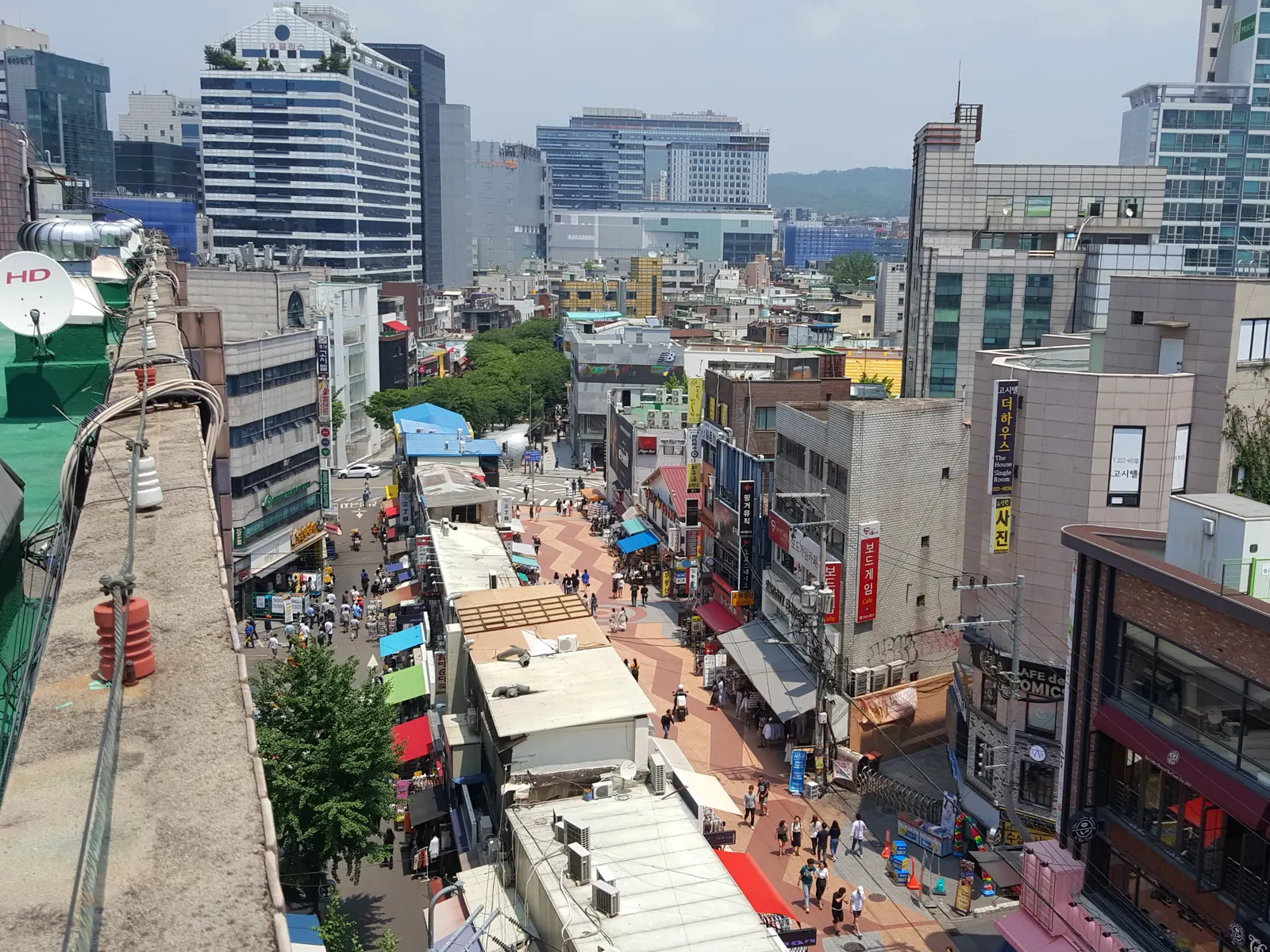
Hongdae used to house art-school applicants, and now it houses foreign tourists
Hongdae is the neighborhood in front of Hongik University, and the name is a short form of Hongik Daehakgyo (Hongik University). Say Hongdae, and clubs, street musicians and clothing shops come to mind first. But open Seoul's lodging license data and the first thing you see is something else. The alleys around Hongdae are also a neighborhood of lodgings. And this is one type of lodging where Koreans cannot stay as guests. The legal name is "foreign-tourist urban homestay business" (외국인관광 도시민박업), and here we will call it a "foreigner homestay." The enforcement decree of Korea's Tourism Promotion Act defines it as an owner receiving foreign tourists in the home where the owner lives. How many such homes does Seoul have, and how many are around Hongdae?
Source: Ministry of Government Legislation, National Law Information Center Enforcement Decree of the Tourism Promotion Act, Article 2 (kinds of tourism business; in Korean)
More than one in five of Seoul's foreigner homestays are around Hongdae
23% — Share of Seoul's foreigner homestays that are in the 12 dongs around Hongdae. 1,759 of the 7,547 in operation
We counted the businesses still operating in the Seoul foreign-tourist urban homestay license list, the list of guest homes registered with district offices for foreign guests. There are 7,547. Of those, 1,759 are in the 12 dongs (neighborhood units) around Hongdae, from Yeonnam, Seogyo and Donggyo to Hapjeong, Mangwon and Yeonhui. That is 23% of the total. By dong, Yeonnam-dong is first in Seoul with 418 homestays and Seogyo-dong second with 368. Sillim-dong in Gwanak-gu is third with 311, and Donggyo-dong is fourth with 258. By district (gu), Mapo-gu, where Hongdae sits, has more on its own than the second- to fourth-ranked districts (Yongsan, Gwanak and Seodaemun) combined. This is not the first time the neighborhood has housed outsiders. In the 1980s and '90s, art-school applicants from outside Seoul stayed here while preparing for their entrance exams.
Source: Seoul foreign-tourist urban homestay business license data — Result produced with Seoul Metropolitan Government public data (서울특별시 공공데이터)
Hongdae was always a place to stay
We opened the Seoul Museum of History's 2018 survey report on the Hongdae area. It describes students from outside Seoul who, during school vacations, took lodgings near Hongdae and attended art cram schools to prepare for art-college entrance exams. Art students' studios came first, before the cram schools. One studio for architecture students was nicknamed "108 Studio" because the deposit was 1 million won and the rent 80,000 won a month: 100 and 8 in units of 10,000 won, which reads 108. Art cram schools that started in studios filled the buildings in the 1980s, and in 1993 there were about 90 schools and studios along one kilometer of the main road. The report traces the roots of club culture to art students' studios. It says those spaces became cafes and clubs. Only the people who stay have changed, from exam candidates to foreigners.
Source: Seoul Museum of History 2017 Seoul Living Culture Survey, "Hongdae Front, Seoul's Cultural Power Plant" (in Korean)
Who stays in the homestays?
3× — People who say they stayed in a guesthouse or homestay — the 20s compared with the 40s. 11.4% of people in their 20s, 3.8% of those in their 40s
Many are young travelers. In the 2025 Foreign Visitors Survey, 11.4% of respondents in their 20s said they stayed in a guesthouse or homestay. That is 3 times the share for people in their 40s (3.8%). People in their 20s spent less on lodging per person than people in their 40s. They spent three times as much as the 40s on what the survey calls cultural services, a separate spending category. They spent less on shopping. But these figures are split by age, not counted for homestay guests alone. Hongdae fills up at night. Foreigners staying short-term in Seogyo-dong, counted as the number in the area at each hour, are most numerous at 9 p.m. On r/koreatravel, an English-language Reddit forum where foreign travelers gather, 24% of posts since 2023 that mention Hongdae also mention clubs, bars or drinking. That is twice the 12% share of posts that mention Myeong-dong, a central Seoul shopping district.
Source: Korea Culture and Tourism Institute 2025 Foreign Visitors Survey (final figures; in Korean) · [Short-stay foreigners] Seoul living population by administrative dong (250 m) · Reddit · Arctic Shift archive API 50,155 posts on r/koreatravel (January 2019 to September 2026) — Result produced with Seoul Metropolitan Government public data (서울특별시 공공데이터)
The airport line opened, and a year later the homestay system began
2.0× — Daily boardings on the Airport Railroad at Hongdae Station — September 2015 → September 2026. Line 2 grew 4% over the same period
September 2015
At the end of 2010 the Airport Railroad was extended to Seoul Station and began stopping at Hongdae Station. Exactly a year later the government created the foreigner homestay system, and a Ministry of Culture, Sports and Tourism press release said taking Korean guests could be punished. Figures from Mapo District Office, quoted in a business magazine article, show guesthouses in Yeonnam-dong growing from about 20 in 2012 to 106 in 2015. "Guesthouse" is a name shops gave themselves, so it may not be counted the same way as foreigner homestay registrations. The Yeonnam section of the Gyeongui Line Forest Park opened in June 2015, so the guesthouses were already there before the park. On an average September day, boardings on the Airport Railroad at Hongdae Station are twice what they were in 2015, while Line 2 grew 4% over the same period.
- December 2010The Airport Railroad reaches Seoul Station and stops at Hongdae Station
- December 2011The foreign-tourist urban homestay system begins
- 2012About 20 guesthouses in Yeonnam-dong (Mapo District Office figures, quoted in a magazine article)
- 2015106 guesthouses in Yeonnam-dong
- June 2015The Yeonnam section of the Gyeongui Line Forest Park opens
Source: Seoul subway boardings and alightings by line, station and hour · Ministry of Culture, Sports and Tourism Press release on the start of the foreign-tourist urban homestay business (in Korean) · Hankyung Business magazine "No. 1 lodging spot for travelers to Korea" (cites Mapo District Office figures; in Korean) · Seoul Metropolitan Government Press release on the opening of the Yeonnam section of the Gyeongui Line Forest Park (in Korean) — Result produced with Seoul Metropolitan Government public data (서울특별시 공공데이터)
Hongdae did not grow, it spread sideways
60% — Share of new homestays around Hongdae outside Yeonnam, Seogyo and Donggyo — 2026. About a quarter until 2022, 44% in 2024
We counted newly licensed homestays around Hongdae, split into the core dongs of Yeonnam, Seogyo and Donggyo and everything outside them. The core grew too, but the outside grew faster. The outside dongs' share was around a quarter until 2022. It reached 44% in 2024 and is 60% in 2026. Of the 48 homestays licensed in Yeonhui-dong this year, 23 are within 300 m of a homestay in Yeonnam-dong. It looks as if Yeonnam overflowed, but that is a guess. Interest on the English forum points the same way. Mentions of Hongdae have stayed at about 40 to 60 per 1,000 posts, while mentions of Mangwon, Hapjeong, Yeonhui and Sangsu went from 5% of the Hongdae mentions in 2022 to 25% in 2026. By Korea Tourism Data Lab figures reported by Newsis, foreign visits to Mangwon Market rose from 270,000 in 2024 to 390,000 in 2025, up 120,000 in a year.
Source: Seoul foreign-tourist urban homestay business license data · Reddit · Arctic Shift archive API 50,155 posts on r/koreatravel (January 2019 to September 2026) · Newsis Article on foreign visits to Mangwon Market (cites Korea Tourism Data Lab; in Korean) — Result produced with Seoul Metropolitan Government public data (서울특별시 공공데이터)
Why did the numbers jump all at once from autumn 2024?
354 licenses — New foreigner homestay licenses in Seoul — the busiest single month, March 2026. 265 in the single month of December 2024
The jump in the numbers coincides with when Airbnb began requiring business registration certificates. New licenses in Seoul as a whole jumped to 265 in the single month of December 2024, right after Airbnb began asking new listings for a business registration certificate that October. This year, after Airbnb stopped taking bookings for unregistered listings, new licenses in Seoul reached 354 in March, the most in any single month. That was a company measure, not a law. In Sangsu-dong, 10 homestays in two row-house and multi-unit buildings built in 2019 were licensed on the same day. We looked up the construction year of homestays licensed in Sangsu and Changjeon after 2024, wherever we could find it. None of them was in a building put up in the year before the license or in the same year. In effect, existing homes were registered all at once. We think it is closer to hidden homes coming into the open than to new ones being added, but numbers cannot tell whether they were hiding or only started then.
- October 2024Airbnb begins asking new listings for a business registration certificate
- December 2024New licenses in Seoul jump to 265 in one month
- January 2026Unregistered listings can no longer take bookings
- March 2026354 new licenses in Seoul, the most in any single month
Source: Seoul foreign-tourist urban homestay business license data · Airbnb "Thriving Together with Korea" — steps toward mandatory business registration · Seoul real-estate rent and deposit price data — Result produced with Seoul Metropolitan Government public data (서울특별시 공공데이터)
Each area grew for a different reason
Seogyo, the area in front of Hongik University, is a night neighborhood. Donggyo and Yeonnam were the first to fill up with homestays. From 2012 to 2015, the growth rate of new restaurant openings in Yeonnam was more than 4 times the Seoul average. Short-stay foreigners in Yeonnam number only a little over one-eighth of those in Seogyo-dong, and their peak hour is 6 a.m. It reads as a place people sleep. Mangwon grew from the second half of 2023 and Hapjeong from the second half of 2024. Monthly rent per 3.3 ㎡ (about one pyeong, the Korean unit of floor area) is 22 to 24% lower than in Yeonnam, and many of the homestays in newly built buildings are in these two areas too. Of the homestays in new buildings licensed after 2024, seven in ten were in Hapjeong, Mangwon and Seongsan-dong to the north. In Sangsu and Changjeon, Mapo Saebit Culture Forest opened in 2021 on the site of the old Dangin-ri power plant, and by the end of the following year an elevator linked it to Mangwon Hangang Park. Even so, the number of shops in Seogang-dong, where Sangsu belongs, rose only 3% in five years. In Yeonhui, new lodgings are concentrated on the side that borders Yeonnam.
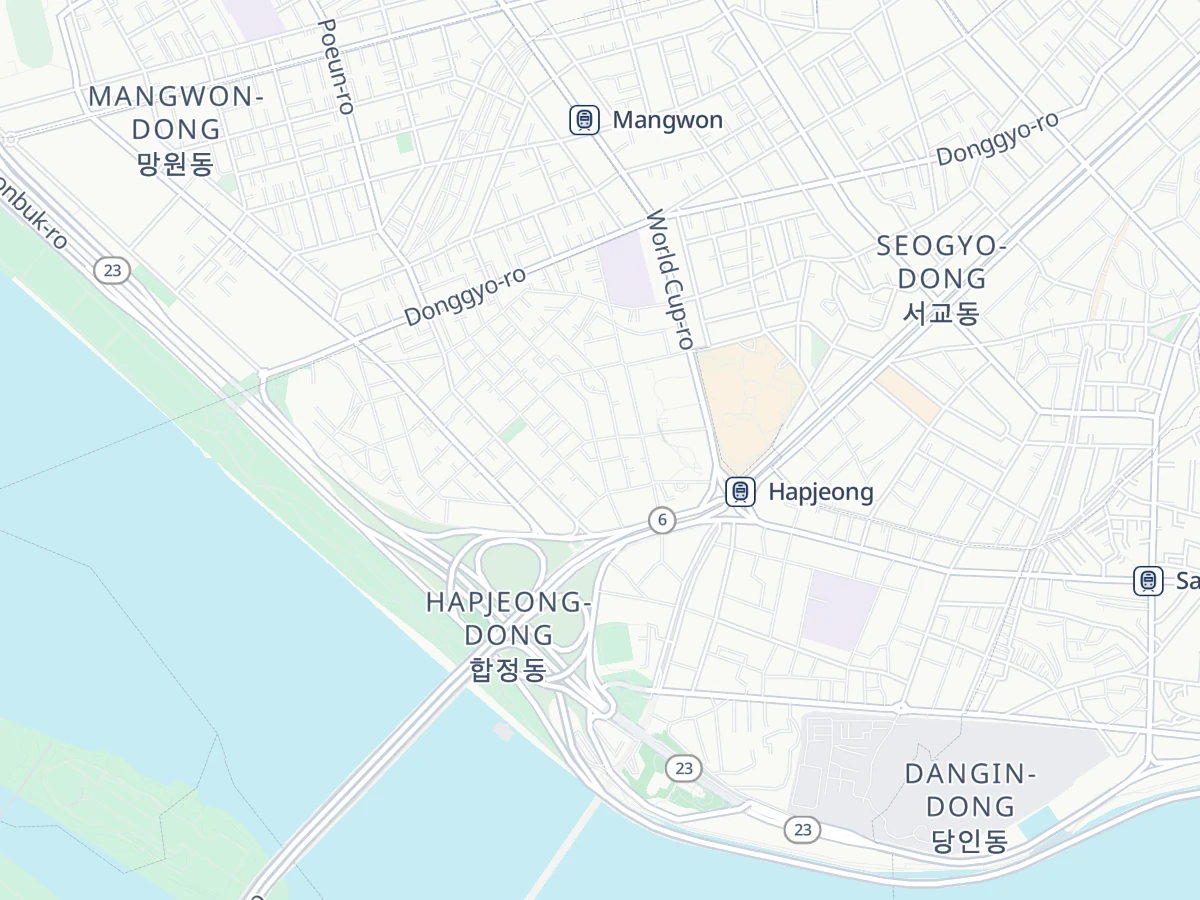
Map © OpenStreetMap contributors · Protomaps
- 1Mangwon Hangang Park — Linked by elevator to Mapo Saebit Culture Forest the following year-end
- 2Seoul Battleship ParkMangwon
- 3Mangwon MarketMangwon
- 4Mangwondonggil Street (Mangnidangil Street)Mangwon
- 5Mangwonjeong PavilionHapjeong–Sangsu
- 6Yanghwajin Foreign Missionary CemeteryHapjeong–Sangsu
- 7Jeoldusan Martyrs' ShrineHapjeong–Sangsu
- 8Mapo Saebit Culture Forest — Opened in 2021 on the site of the old Dangin-ri power plant
- 9Sangsu-dong Cafe StreetHapjeong–Sangsu
- 10Jebi DabangHapjeong–Sangsu
Source: Seoul Institute, Seoul Urban Studies "Survival rates of commercial facilities and their factors as commercial areas spread: restaurants in the Hongdae area" (in Korean) · [Short-stay foreigners] Seoul living population by administrative dong (250 m) · Seoul real-estate rent and deposit price data · Seoul foreign-tourist urban homestay business license data · Seoul Commercial District Analysis Service (stores by administrative dong) — Result produced with Seoul Metropolitan Government public data (서울특별시 공공데이터)
Names and stories left in the alleys
Behind the numbers for each neighborhood the lodgings spread to, there is an older story. The names Seogyo-dong and Donggyo-dong come from Jandari, a small bridge that once crossed a stream. The alley opposite Sanwoollim Theater follows the old Gyeongui Line tracks, and when a train passed, the crossing gate rang "ttaeng ttaeng," so it was called Ttaeng Ttaeng Alley. Mapo District Office presents this alley as where Hongdae culture began. On Gyeongui Line Book Street, a book-themed street built on the old railway, the sculpture "Forest of Text" stands on 71 pillars, which a citizen reporter for Seoul Media Hub says stand for the stations of the old Gyeongui Line. Hongdae Pedestrian-Friendly Street, with grilled-meat restaurants on both sides, also got the nickname "Street You Want to Grill"; in Korean the two names sound almost the same (geotgo sipeun geori and gupgo sipeun geori). In the playground in front of Hongik University's main gate, a flea market selling only handmade goods ran on Saturdays from March to November starting in 2002. The organizers wrote on their blog in spring 2025 that there is no flea market now, and the playground now holds the creative space "Drawing Village."
Yeonnam-dong is the youngest dong in Mapo, split off from Yeonhui-dong. The triangular pond in the forest park is said to be set where the old stream "Songjangnae" ran. Postcards put into the park's mailbox are said to be sent twice a year, around Seollal (Lunar New Year) and Chuseok (the autumn harvest holiday) (Seoul Media Hub citizen reporter).
Mangwonjeong, the pavilion that gave Mangwon-dong its name, is actually in Hapjeong-dong. When King Sejong climbed it, rain fell after a drought, so its first name was "Huiujeong" (roughly "pavilion of welcome rain"). Hapjeong's name comes from a well with many shells. On the Yanghwajin hill, a foreigners' cemetery has existed since 1890, and 417 people from 15 countries are buried there.
Dangin-dong's name goes back to the Imjin War, when a Japanese army and the army of Ming China under General Li Rusong camped in the area. Since Koreans called China the land of Tang, the place was called "Daengmal" (Tang village), and that later became Dangin-dong. In Changjeon-dong stands the shrine to King Gongmin, a nationally registered cultural heritage. The Korea Heritage Service writes that it was built to honor King Gongmin, who appeared in the dream of a man guarding a granary.
Yeonhui-dong's name comes from Yeonhuigung, a detached palace that King Sejong rebuilt in 1420 for his father, King Taejong. In 1969 a Chinese school moved here from Myeong-dong and a Chinese community formed. Seoul Love, a Seoul city website, writes that on the Yeonhui side the Chinese restaurants are places for a formal meal, while across the underpass on the Yeonnam side they are casual Chinese places you can drop into. Cafe Pokpo ("pokpo" means waterfall) stands in front of the artificial waterfall on the Hongjecheon stream in Yeonhui-dong. Seodaemun District said from the cafe's early days that it would return the profits to the community, and it uses them for scholarships for university, middle and high school students.
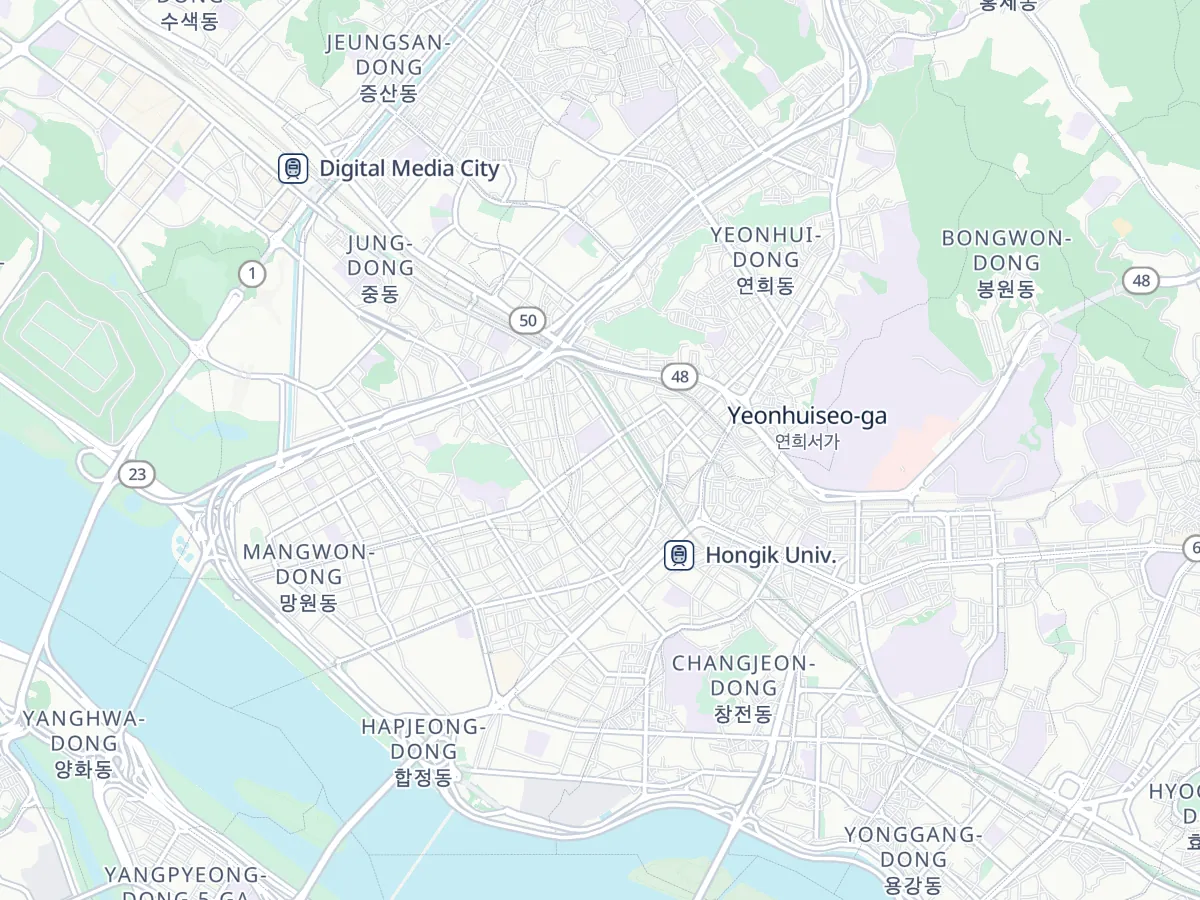
Map © OpenStreetMap contributors · Protomaps
- 1Hongdae Ttaeng Ttaeng Alley — On the old Gyeongui Line track — the alley where the crossing gate rang "ttaeng ttaeng" when a train passed
- 2Hongdae Pedestrian-Friendly Street — Grilled-meat restaurants on both sides gave it the nickname "Street You Want to Grill"
- 3Gyeongui Line Forest Park — A triangular pond on the old stream "Songjangnae" · a mailbox that sends postcards twice a year
- 4Mangwonjeong Pavilion — The pavilion that gave Mangwon-dong its name — first called "Huiujeong"
- 5Yanghwajin Foreign Missionary Cemetery — A foreigners' cemetery since 1890 — 417 people from 15 countries
- 6King Gongmin's Shrine — Changjeon-dong — a nationally registered cultural heritage
- 7Hongjecheon Artificial Waterfall — Money earned at the cafe in front goes to scholarships for university and school students
Source: Mapo District Office Origins of the dong names (in Korean) · Mapo District Office Main tourist spots of Hongdae (in Korean) · Seoul Media Hub Citizen reporter's article on the Yeonnam section of the Gyeongui Line Forest Park (in Korean) · Living & Art Creative Center Official blog post by the organizers of the flea market (in Korean) · Korea Heritage Service Nationally registered cultural heritage: King Gongmin's Shrine, Changjeon-dong (in Korean) · Seoul Metropolitan Government Stories of Yeonhui-dong and Yeonnam-dong, "Seoul Love" (in Korean) · Seoul Shinmun Article on Cafe Pokpo's profits going to scholarships (in Korean)
'Hongdae or Myeong-dong?' — the number of lodgings is not the number of people sleeping
96% — Share of lodgings around Hongdae that are foreigner homestays. 1,759 of 1,838 — a homestay has fewer than 2 rooms on average
The most common "A or B" question on r/koreatravel since 2023 is "Hongdae or Myeong-dong," in 99 posts. By number of lodgings, Hongdae is a homestay neighborhood. Around Hongdae there are 1,759 foreigner homestays, 35 hotels with a tourist-lodging license and 44 places with the ordinary general-lodging license. Homestays are 96% of the lodgings, and a homestay has fewer than 2 rooms on average. So the number of lodgings and the number of people sleeping are different things. On a September average between 3 and 5 a.m., there were 5,667 foreigners in Myeong-dong and 4,348 in Seogyo-dong. By people sleeping at night, Myeong-dong is ahead.
Source: Seoul foreign-tourist urban homestay business license data · Seoul tourist lodging business license data · Seoul lodging business license data · [Short-stay foreigners] Seoul living population by administrative dong (250 m) · Reddit · Arctic Shift archive API 50,155 posts on r/koreatravel (January 2019 to September 2026) — Result produced with Seoul Metropolitan Government public data (서울특별시 공공데이터)
Is there a downside?
146 cases — Illegal-lodging criminal cases opened by the Seoul city — 2024. It was 17 in 2022
There is. In 2015 the Ministry of Culture, Sports and Tourism inspected 132 guesthouses in four Seoul districts and found that 44 were operating without registration. An official said complaints about music at night and trash left in the street were frequent (Korea Times). The Seoul city opened 17 criminal cases for illegal lodging in 2022 and 146 in 2024, but most involved officetels (small studio-style apartments), gosiwon (tiny rented rooms) and multi-unit houses, and the cases are not only from Hongdae. As lodgings grew, the rules got heavier. From August this year, foreigner homestays too must post and follow a price list, and a first offense means a 5-day business suspension.
Source: The Korea Times "1 in 3 guesthouses have no licenses" · Seoul Metropolitan Government Press release on the crackdown on illegal lodging (in Korean) · Newsis Article on the duty to post price lists at foreigner urban homestays (in Korean)
What these numbers miss
The number of homestays is not the number of guests. In the 2025 survey, eight in ten foreigners who stayed in Seoul stayed in hotels. Homestays or pensions (the survey's category for small holiday-style lodgings) and guesthouses or hostels made up just 7% between them. Unregistered lodgings are not in these numbers, and the number of guesthouses for 2012 to 2015 comes from newspaper articles. A homestay that closed and was licensed again can be counted twice as new licenses. The 12 dongs "around Hongdae" are also a range we drew, not an official area. The English forum covers only posts written in English, so the voices of Thai visitors, one in three of the short-stay foreigners in Seogyo-dong, are not counted separately. Boardings on the Airport Railroad at Hongdae Station may include people commuting to Gimpo and Incheon. The noise and trash that residents experience are not counted by these numbers.
Source: Korea Culture and Tourism Institute 2025 Foreign Visitors Survey (final figures; in Korean)
So, a reason to walk around Hongdae
There are a few places where the numbers above can be seen. Ttaeng Ttaeng Alley, which Mapo District Office presents as where Hongdae culture began, is an alley that follows the old railway. The Gyeongui Line Forest Park, opened when Yeonnam guesthouses were growing from about 20 to 106, runs beside that alley. At Mangwon Market, foreign visitors grew by 120,000 in a year. From there you can walk on to Mangwon Hangang Park on the Han River, and an elevator links the park to Mapo Saebit Culture Forest, so the market and the river are connected in one path. One caution: the area in front of Hongdae (Seogyo-dong) has the most foreigners around 9 p.m., so at that hour it is not a quiet alley.
Walking the route the lodgings spread along
The people who stay have changed from exam students to foreigners, but this is still a neighborhood where outsiders stay and walk the alleys. Following the neighborhoods the lodgings spread to, you can walk from Hongdae Station along the Gyeongui Line Forest Park to Mangwon Market, Mangwon Hangang Park and Mapo Saebit Culture Forest. This is TripSem's series on neighborhoods read by the numbers, and the last one was Seongsu.
- Hongdae Station
- Gyeongui Line Forest Park
- Mangwon Market
- Mangwon Hangang Park
- Mapo Saebit Culture Forest
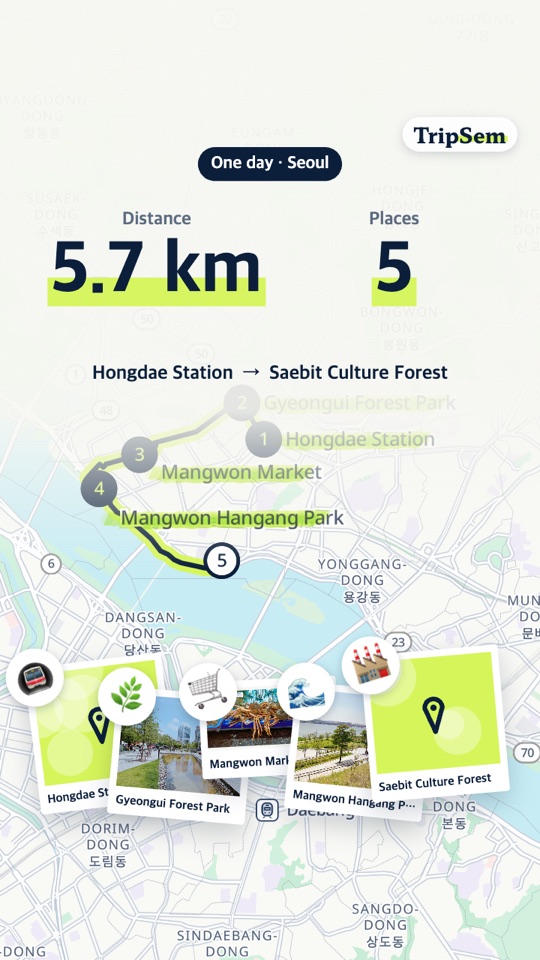
Getting there: the route starts at Hongdae Station (Line 2, the Airport Railroad and the Gyeongui-Jungang Line), Mangwon Market is about a 5-minute walk from Mangwon Station on Line 6, and Mapo Saebit Culture Forest is reached from Sangsu Station on Line 6.
If this is your first trip to Korea, our eSIM calculator works out how much mobile data a day you will need.
Places in Hongdae 43
All HongdaePlaces: 11Yeonnam–YeonhuiPlaces: 10Hapjeong–SangsuPlaces: 11MangwonPlaces: 11
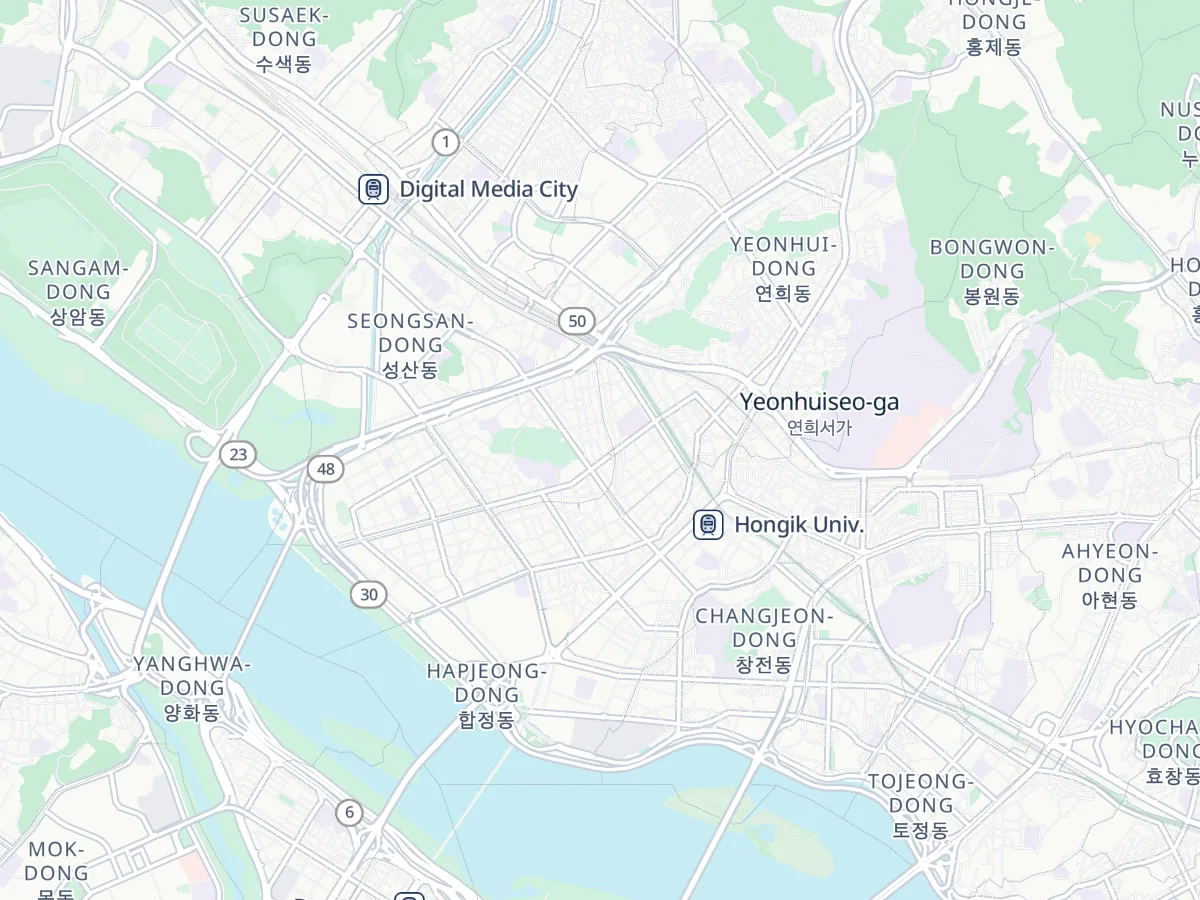
Map © OpenStreetMap contributors · Protomaps
This is an affiliate link: we may earn a commission if you book through it.
Hotels near HongdaeAffiliateHongdaeSeogyo-dong · Donggyo-dong · 11 places
-
Hongdae Pedestrian-Friendly Street
Eoulmadang-ro, where the Hongdae Pedestrian-Friendly Street lies, follows the old Dangin-ri railway line.
Getting thereHongdae Station (Line 2), Exits 8 and 9, then straight toward Hongik University
More details
Trains carrying anthracite coal to the power plant ran here from 1929, and passenger service ended in 1975 and freight service in 1980.
Street performances are allowed only at designated places and not after 10 p.m. The Mapo Tourist Information Center (22 Hongik-ro) gives information in English, Chinese and Japanese from 10:00 to 19:00, and is closed on the day before and the day of holidays such as Seollal and Chuseok.
BookingNo reservation needed; it is a street you simply walk. Busking slots are chosen by lottery after Mapo District accepts applications.
AdmissionFree
Source: Mapo District Office Culture & Tourism — Hongdae Pedestrian-Friendly Street · Introduction mcst.go.kr · Photo Michaela den · CC BY-SA 3.0 · Checked Oct 22
-
Hongdae Ttaeng Ttaeng Alley
A path of a little over 200 m that follows the old railway from the alley opposite Sanwoollim Theater to below Wau Bridge.
Getting thereHongdae Station (Line 2, Airport Railroad, Gyeongui-Jungang Line), Exit 6 · Seogang Univ. Station (Gyeongui-Jungang Line)
More details
It is named for the "ttaeng ttaeng" sound the crossing gate made as it came down when a train passed. Mapo District presents it as the birthplace of the Hongdae culture represented by music and art.
Seoul's park guide says that on the Wau Bridge section of the Gyeongui Line Forest Park (about 370 m, about 15 minutes on foot), the railway crossing once called Ttaeng Ttaeng Alley has been restored as it was. The Gyeongui Line Book Street and an observation deck are in the same section.
BookingNo reservation needed; it is an alley you simply walk.
AdmissionFree
Source: Mapo District Office Culture & Tourism — main tourist spots of Hongdae (Ttaeng Ttaeng Alley) · Photo Christian Bolz · CC BY-SA 4.0 · Checked Oct 22
-
KT&G Sangsangmadang Hongdae
A building that opened in September 2007, with four floors below ground and seven above, holds an independent and art cinema, a live hall, a gallery and an academy, and also has a darkroom for developing photos.
Getting thereHongdae Station (Line 2), Exit 9 · Hapjeong Station, Exit 3 · Sangsu Station (Line 6), Exit 1
More details
The operator describes the building, on Picasso Street near Hongik University, as a place meant to help artists create and let citizens enjoy culture.
Inside are an independent and art cinema on the 4th basement floor, a live hall on the 2nd basement floor, a gallery, Design Square (a living and gift store) and a cafe. The Signature Tour, with a docent's commentary, must be paid for up to 3 days before the day of use and is for ages 14 and over, up to 15 people.
BookingNo reservation is needed to enter the building. Performances, films and classes are booked or applied for separately for each program, and space tours are applied for by the phone number or email in the official notice.
AdmissionFree
ParkingNone — there is no separate parking, so public transport is recommended
NoticeIn the gallery (floors 3–5), the Lee Kyung-mo photo exhibition 《Days of the Same Weight》 runs until November 22. Closed Mondays, 11:00–19:00 (last entry 18:30).
NoticeIn Design Square on the 1st floor, the pop-up 「WEAR SEOUL, KEEP KOREA」 (free admission, 11:00–21:00) runs until November 8.
Source: KT&G Sangsangmadang official — Hongdae introduction and directions · Photo Korea Tourism Organization · KOGL Type 1 · Checked Oct 23
-
Rolling Hall
A live music venue that opened in 1995 as the club Rolling Stones and moved to the front of Hongdae in 2004.
Getting thereSangsu Station (Line 6), Exit 1 · Hapjeong Station, Exit 5
More details
It uses the 1st basement floor and the 2nd floor, and its official site says it was registered as a performance venue under the Performance Act in January 2012.
Both seated and standing shows are listed, so you need to check the viewing type for each show. The official site gives the price, viewing type and running time in each show's details.
BookingFor each show, book through the ticket seller named in the show's details on the official site (for example Melon Ticket), or buy on the day at the venue.
ParkingNone — the building has no parking, so use the nearby roadside public lots or Seogyo-dong Private Lot No. 4
Source: Rolling Hall official — greeting and directions · Photo Korea Tourism Organization · KOGL Type 3 · Checked Oct 23
-
Club Evans
A club that has kept live jazz going in front of Hongdae since September 2001.
More details
Every evening it plays two sets with a break between (set 1 at 8:00, set 2 at 9:20). Its official introduction says nothing stands between the stage and the guests' tables.
Because it serves alcohol, minors can enter only with a guardian (legal representative). You must order one drink in addition to the entrance fee.
HoursDaily 20:00–22:10 (entry from 19:00 · set 1 20:00–20:50 · 30-minute break · set 2 21:20–22:10)
BookingNo reservation; guests are seated in order of arrival.
Admission₩20,000
Source: Club Evans official — About and FAQ · Photo hojusaram · CC BY-SA 2.0 · Checked Oct 23
-
Seogyo 365
A shopping street of long, narrow buildings 2 to 5 m wide that run about 250 m across 23 lots around Seogyo-dong 365, so the lot number became the name of the street.
More details
Seoul selected it as Seoul Future Heritage in 2013, and its site compares the shape to a train standing still.
The road in front of the buildings falls within the "Red Road" (the Gyeongui Line Forest Park, Hongdae, Seogyo 365 and the Dangin-ri power plant, about 2 km), designated a Hongdae tourism special street in 2023.
BookingNo reservation needed; it is a shopping street you simply walk.
AdmissionFree
Source: Seoul Future Heritage — Seogyo 365 in front of Hongdae · Checked Oct 23
-
Gyeongui Line Book Street
A book-themed street finished in October 2016 on the closed Gyeongui Line.
Getting thereHongdae Station (Line 2, Gyeongui-Jungang Line, Airport Railroad), Exit 6, 54 m
More details
Mapo District presents it as a place that brings back today the chaekgado (bookshelf painting) culture of King Jeongjo's time.
Seoul Tourism Organization says a walking program on books is held once a month and visitors can meet authors. The district office's guide lists a different book program for each day of the week (Tue humanities, Wed art, Thu travel, Fri literature, Sat children, Sun performance and lectures), and these change with operations.
HoursTue–Sun 11:00–20:00 / closed Mondays
BookingNo reservation needed; it is a street you simply walk.
AdmissionFree
Source: Mapo District Office Culture & Tourism — Gyeongui Line Book Street · Photo Korea Tourism Organization · KOGL Type 1 · Checked Oct 23
-
Drawing Village
Land that was made into Hongik Cultural Park in 1984 was reborn in December 2025 as the arts and culture space 「Drawing Village」, with a shared studio and a creative center.
Getting thereSangsu Station (Line 6), Exit 1, 549 m
More details
Seoul Tourism Organization writes that it has been merged with the Red Road, which it counts as a center of art, culture and tourism.
It has a shared studio where individual artists and art groups work, and it also holds exhibitions. Its old name was Hongik Cultural Park (Hongik Children's Park, also called Hongdae Playground), so the district office's guide still carries that name.
HoursCreative center daily 09:00–18:00 · shared studio daily 13:00–18:00
BookingThe official guide does not describe a reservation procedure. For inquiries, call the creative center at 02-322-6162 or 02-322-6165.
AdmissionFree
NoticeMapo District Office's guide still lists this as Hongik Children's Park, with a flea market every Saturday. In March 2025 the organizers wrote on their blog that there is no flea market now.
Source: Seoul Tourism Organization VisitSeoul (English) — Hongdae Playground (Drawing Village) · Checked Oct 23
-
Theater Sanwoollim
A small theater opened in March 1985 by the Sanwoollim theater company, which was formed in December 1969 to stage Samuel Beckett's Waiting for Godot for the first time in Korea.
Getting thereHongdae Station (Gyeongui-Jungang Line, Line 2, Airport Railroad), Exit 6, about 327 m (along the Gyeongui Line Book Street and over Wau Bridge)
More details
Waiting for Godot is still the company's signature work, and it was staged again in 2015 for the theater's 30th anniversary.
The basement is the small theater, and floors 1 and 2 are a gallery, art shop and workshop called Sanwoollim Art & Craft. The first floor also sells coffee, drinks and wine, and you can rest on stage furniture used in the plays.
Hours1st floor 11:00–21:00 · Art & Craft inquiries 12:30–19:30 · theater inquiries 11:00–18:00 / closed Tuesdays / show times differ by show
BookingBook each show through "Book online" in the show information on the official site.
ParkingNone — there is no parking facility, so use nearby public lots (Saemulgyeol and Donggyo 1 roadside lots, Donggyo-dong 1)
NoticeThe theater announced that it would stop operating for remodeling (planned March to early August 2026), and on August 6 a notice of construction delay was posted. Check the official site for the next show schedule before you go.
Source: Theater Sanwoollim official — about and directions · Photo Korea Tourism Organization · KOGL Type 3 · Checked Oct 23
-
Thanks Books
A curated bookstore in front of Hongdae that opened in March 2011 and holds a themed exhibition once a month with a publisher.
More details
Its official site says it does not stock independent publications, so that each bookstore nearby can keep its own character.
It sells sundries as well as books, and members (free to join) earn 10% of what they spend as points, which can be used on both books and sundries.
BookingNo reservation needed; it is a bookstore you simply walk into.
AdmissionFree
Source: Thanks Books official — About · Checked Oct 23
-
Homi Art Supplies
An art-supply store that opened in Seogyo-dong, Mapo-gu, in 1975 and is now in its second generation.
More details
Seoul selected it as an Old Shop in 2018 and as Seoul Future Heritage in 2020. The Seoul Future Heritage article records a story of art students who ran out of materials while working and held the shutter open, and an explanation that it has opened with a rule of closing only two days, Seollal and Chuseok.
A shop specializing in art materials, using the 1st and 2nd floors. The Seoul Future Heritage article writes that it is known well enough that buyers come from Hong Kong and Taiwan.
HoursWeekdays 09:00–20:50 / weekends and public holidays 10:00–19:50
BookingNo reservation needed; it is a store you simply walk into. There is also an online shop of the same name (homi.co.kr).
AdmissionFree
Source: Homi Art Supplies official shop — store information · Introduction futureheritage.seoul.go.kr · Photo Korea Tourism Organization · KOGL Type 3 · Checked Oct 23
Yeonnam–YeonhuiYeonnam-dong · Yeonhui-dong · 10 places
-
Gyeongui Line Forest Park
A park of about 1.2 km on the old Gyeongui Line track, from Hongdae Station to the Yeonnam intersection, commonly called Yeontral Park.
Getting thereHongdae Station (Line 2, Gyeongui-Jungang Line, Airport Railroad), toward Exit 3 · the other end is Gajwa Station on the Gyeongui-Jungang Line
More details
The section has a waterway that recreates the old stream Segyocheon.
The roughly 200 m from Hongdae Station Exit 3 to the Yeonnam police box is the busking zone, where performances are allowed only between 11:00–13:00, 14:00–16:00 and 17:00–19:00 every day. Park information is given at the Yeonnam guard post (in front of the Yeonnam police box).
BookingNo reservation needed; it is a park you simply walk. Only busking in the Yeonnam section is applied for, free and first come, first served, through the Seoul Public Service Reservation.
AdmissionFree
ParkingNone — there is no parking lot in the park, so public transport is recommended
Source: Seoul Metropolitan Government Parks — Gyeongui Line Forest Park · Photo Brit in Seoul · CC BY-SA 4.0 · Checked Oct 22
-
Hongjecheon Artificial Waterfall
An artificial waterfall 25 m high and 60 m wide hangs over the Hongjecheon stream.
Getting thereHongje Station (Line 3), Exit 3, 1.2 km (to Cafe Pokpo) · from Exit 4, take bus 7713 or 7738 to Baengnyeon Bridge stop, then 213 m
More details
The Cafe Pokpo opposite opened in 2023 as the first of Seoul's "waterfront sensibility city" sites. Seodaemun District gives student scholarships from a fund made from the cafe's profits.
The Seodaemun Tourist Information Center, Hongjeguk Falls branch (next to Cafe Pokpo), is open daily 10:00–19:00. Seoul Tourism Organization says that in winter the falls turn into a huge wall of ice and people come to see it.
HoursThe falls run daily 08:00–21:00. Cafe Pokpo in front of the falls is open daily 09:00–21:00 with no days off.
BookingNo reservation needed; it is a place you simply look around.
AdmissionFree
ParkingAvailable · Hongje Falls Plaza lot open 24 hours, 500 won per 5 minutes (first 10 minutes free), up to 40,000 won a day · 1 hour free if you show a Cafe Pokpo receipt
Source: Seoul Tourism Organization VisitSeoul — Seodaemun Hongje Falls · Introduction english.visitseoul.net · Photo Huntsmanleader · CC0 · Checked Oct 22
-
Seodaemun Museum of Natural History
A museum opened by Seodaemun District in 2003, which its operator describes as Korea's first public general natural history museum.
Getting thereSinchon Station (Line 2), Exits 3 and 4, then Seodaemun 03 village bus to Seodaemun Museum of Natural History stop · Hongje Station (Line 3), Exits 3 and 4, then bus 7738 to the same stop
More details
Its exhibition halls include "Sharks of Korea" and "3 Billion Years of the Korean Peninsula," and its collection holds 56,000 specimens.
Seodaemun residents enter free with ID and a residence certificate issued within the past 6 months, and on "Culture Day" (the last Wednesday of each month) the admission fee is 20% off. There is a Book Park for reading on the 3rd floor, and a dinosaur slide and a fossil-hunting playground outdoors.
HoursMar–Oct weekdays 09:00–18:00, Saturdays and public holidays 09:00–19:00 / Nov–Feb weekdays 09:00–17:00, Saturdays and public holidays 09:00–18:00. Tickets and entry end 1 hour before closing. Closed every Monday (the next day if Monday is a holiday), January 1, and on the days of Seollal and Chuseok.
BookingTickets are sold only at the ticket office on site; advance booking is not available. Groups of 20 or more have a separate group-visit reservation on the official site.
Admission₩7,000
ParkingAvailable · 47 spaces (2 large, 45 small) · small cars 3,000 won for the first 2 hours, then 500 won per 10 minutes · left open for free on closed days
Source: Seodaemun Museum of Natural History official — admission · Photo Korea Tourism Organization · KOGL Type 1 · Checked Oct 23
-
Yeonhui Literary Creation Village
Seoul's first creative space devoted to literature, opened in 2009 in the renovated former building of the Committee for the Compilation of History.
Getting thereHongdae Station (Line 2), Exit 8 → bus 7612, 7734, 7739 or 8773 → get off at Seodaemun Bohun Hall stop and walk about 150 m
More details
Its 19 writing rooms are divided among four buildings named "Kkeullim," "Hollim," "Ullim" and "Deullim," and the outside paths are open for citizens to walk while the writers work.
Chaekdabang Yeonhui, in the basement, is an unstaffed cafe where you can read about 8,000 books and periodicals. Literary events such as readings are held on the open-air stage "Yeollim" (100 seats). The schedule is posted in the program section of the Seoul Foundation for Arts and Culture site.
HoursThe outside spaces other than the writing rooms, and Chaekdabang Yeonhui, are open on weekdays 10:00–17:00. Closed on weekends, holidays and public holidays. The writing rooms are the living space of resident writers, so outside visitors cannot enter.
BookingYou can look around the outside paths and Chaekdabang Yeonhui on weekday daytimes without a reservation. You cannot enter the building with the writing rooms.
AdmissionFree
ParkingOnly disabled parking is in the official guide (there is no general parking information)
Source: Seoul Foundation for Arts and Culture — Yeonhui Literary Creation Village facilities · Checked Oct 23
-
Ansan Red Clay Trail
A barefoot red clay trail that Seodaemun District built on the Ansan mountainside road, 550 m long and 2 m wide.
Getting thereThe Seodaemun attractions loop shuttle bus stops at Ansan Hwangtotgil stop after Hongje Station (Exit 3) (based on an older district newsletter — check the current route on the Seodaemun Facilities Management Corporation site)
More details
The first 450 m section is covered with a greenhouse-style roof so it can be walked in snow and rain, and a fog system in the lamps keeps the clay from drying out.
There are three foot-washing stations, and next to the first is a red clay foot bath. At the opening, a notice said that people with athlete's foot or foot wounds and pet dogs cannot use it. The district office said the number of visitors since opening has passed 1.2 million.
HoursOpen all year
BookingNo reservation needed; it is a trail you simply walk. There is a shoe rack at the entrance where you leave your shoes before walking.
AdmissionFree
Source: Seodaemun District Office Culture & Tourism — Ansan Red Clay Trail · Photo An Yeonggwan · Korea Tourism Organization Photo Korea · KOGL Type 1 · Checked Oct 23
-
Yeonhui Forest Rest Area
A rest area built in about a year after construction began in August 2010; before that it was forest land on the Ansan slope, thick with plants.
Getting thereHongje Station (Line 3), Exit 3 → Seodaemun 04 village bus → get off at the Seodaemun Public Health Center Annex · Hongje Falls stop, then 706 m (the stop name is a Korean rendering of the VisitSeoul English guide)
More details
About 10,000 ㎡ beside the Youth Training Center behind Seodaemun District Office hold a cherry blossom yard and a herb garden.
It has a herb garden, a cherry blossom yard, a lawn, the Ansan Pond and an octagonal pavilion in one place. A wetland, a stream facility and the Hongjecheon waterside yard are also introduced as part of the same area.
HoursOpen all year · always open
BookingNo reservation needed; it is a park you simply walk into.
AdmissionFree
Source: Seodaemun District Office Culture & Tourism — Yeonhui Forest Rest Area · Introduction tongblog.sdm.go.kr · Photo Korea Tourism Organization · KOGL Type 1 · Checked Oct 23
-
Gungdong Neighborhood Park
A park on the north side of the low Gungdongsan, 104.3 m above sea level, whose name means "the mountain with a palace." When the hiking trails were improved in 2024, an earth path for walking barefoot was added.
More details
Inside the park are the Gungdongsan gym where residents exercise and a level loop path that anyone can walk easily. The Yeonhui Hill 104 Battle Monument is on the same Gungdongsan slope.
BookingNo reservation needed; it is a park you simply walk up.
AdmissionFree
Source: Seodaemun District Office, Yeonhui-dong Community Center — neighborhood sights (Gungdong Neighborhood Park) · Checked Oct 23
-
Yeonhui Hill 104 Battle Monument
A name like "Hill 104," which sounds like something near the armistice line, is found in Yeonhui-dong in central Seoul.
Getting thereBy bus, get off at the stop in front of the old Seongsan Hall and follow the signs up (district blog guide · no subway directions)
More details
In September 1950 the Korean Marine Corps took the hill, the route to retaking Seoul, after fierce fighting. Seodaemun District writes that 178 allied soldiers were lost and 1,750 Communist soldiers were killed.
Seoul has selected the "Yeonhui Hill 104 battlefield" as Seoul Future Heritage and manages it. In front of the monument is an inscription honoring the marines who died.
BookingNo reservation needed; it is a monument you simply visit.
AdmissionFree
Source: Seodaemun District Office blog — the story of Yeonhui-dong Hill 104 (Yeonhui Hill) · Photo Korea Tourism Organization · KOGL Type 1 · Checked Oct 23
-
Jang Hui-bin Well Site
One of the wells that appeared in the villages around Yeonhuigung Palace, named this way because Jang Hui-bin's family home was close by.
More details
The well, said to have given her water, was restored close to its original form in 2009 under the "Treasure Hunt in Our Neighborhood" project.
The district office explains that after King Jeongjong gave up the throne he used this place as a refuge palace, that it was called Yeonhuigung in the time of King Sejong, and that wells appeared throughout the village as homes of the officials and palace women who looked after the palace were built.
BookingNo reservation needed; it is a well site you simply look around.
AdmissionFree
Source: Seodaemun District Office, Yeonhui-dong Community Center — neighborhood sights (Jang Hui-bin Well Site) · Checked Oct 23
-
Yeonnam-dong Semo-gil (Triangle Alley)
An alley around land shaped like a triangle ("semo") where the end of the Yeonnam section of the Gyeongui Line Forest Park meets the Gyeongui-Jungang Line tracks.
More details
Mapo District Office says the alley came alive as small shops such as leather workshops, wine shops and tailor shops and studios moved in one by one.
BookingNo reservation needed; it is an alley you simply walk. Workshops and shops have different opening hours.
AdmissionFree
Source: Mapo District Office Culture & Tourism — Yeonnam-dong Semo-gil · Checked Oct 23
Hapjeong–SangsuHapjeong-dong · Sangsu-dong · Dangin-dong · Hajung-dong · Sinjeong-dong · Changjeon-dong · 11 places
-
Mangwonjeong Pavilion
A pavilion Grand Prince Hyoryeong built as a villa in 1424, and the origin of the name of the neighborhood Mangwon-dong.
Getting thereHapjeong Station (Lines 2 and 6), Exit 8, 872 m
More details
The present building was rebuilt in 1989 after the original was lost in the flood of 1925; the outer plaque reads "Mangwonjeong" and the inner plaque reads "Huiujeong."
Gangbyeonbuk-ro lies between the pavilion and the Han River. We could not find an official guide on opening and closing times or on whether you may go up and sit inside the pavilion.
BookingThe official guide has no reservation procedure.
AdmissionFree
Source: Korea Heritage Service heritage portal — Mangwonjeong site (Seoul Monument No. 9) · Introduction mediahub.seoul.go.kr · Photo Cultural Heritage Administration · KOGL Type 1 · Checked Oct 22
-
Yanghwajin Foreign Missionary Cemetery
On land the Joseon government bought in 1890 as a foreigners' cemetery, 417 people from 15 countries are buried.
Getting thereHapjeong Station (Lines 2 and 6), Exit 7, then about 200 m along the side path toward Yanghwajeong straight ahead
More details
Ernest Bethell, the Briton who founded the Daehan Maeil Sinbo newspaper, lies here, and Soda Kaichi, who cared for more than a thousand Korean orphans, is the only Japanese buried here.
Food and drink may not be brought into the cemetery, and photos may be taken only on the paths between the graves. With a guided visit, watching a video, a tour of the cemetery and a visit to Yanghwajin Hall take about 1 hour to 1 hour 10 minutes.
HoursMon–Sat 10:00–17:00. On Saturdays, only guided-visit reservation holders may enter the cemetery, 10:00–15:00, and it is closed on Sundays. There is no guided visit on New Year's Day, the Seollal holidays, the Chuseok holidays and Christmas.
BookingYou can walk around the cemetery during opening hours without a reservation. The guided cemetery visit and the Yanghwajin Hall tour must be booked on the official site by 6 p.m. the day before your visit; same-day booking is not possible.
AdmissionFree
ParkingAvailable (free) · cars and vans of 12 seats or fewer park in the cemetery lot; vehicles of 15 seats or more use the nearby Mangwon Lot No. 1 (paid)
Source: Yanghwajin Foreign Missionary Cemetery official (Centennial Church) — visitor information · Photo Seefooddiet · CC BY-SA 4.0 · Checked Oct 22
-
Jeoldusan Martyrs' Shrine
A memorial church and museum built in 1967 on Jamdubong, where believers were executed during the Byeongin Persecution of 1866.
Getting thereHapjeong Station (Lines 2 and 6), Exit 7, about 450 m on foot (10 minutes)
More details
The martyrs executed here are estimated at around 200, but only 29 can be identified by name from records.
The shrine grounds are alcohol-free and smoke-free, and photos inside the church and museum may be taken only by prior arrangement. Food may not be brought into the church and museum, and bicycles, kick scooters and other personal transport may not be used in the outdoor exhibition space.
HoursThe Museum of Korean Catholic Martyrs is open 9:30 a.m.–5 p.m. and closed on Mondays, January 1 and the Seollal and Chuseok holidays. The Byeongin Martyrs Centennial Memorial Church and the saints' relics room are open 7 a.m.–5 p.m. (the church until 1 p.m. on Mondays; the relics room cannot be entered during Mass).
BookingWalk in without a reservation. On Saturdays and Sundays a volunteer-led pilgrimage (50 minutes) starts in front of the education center with no reservation, and group pilgrimages are by application.
AdmissionFree
ParkingAvailable · outdoor lot inside the shrine, 7 a.m.–6 p.m. · the fee is not in the official guide · no parking for buses or for vehicles not visiting the shrine
NoticeIn the museum's basement special exhibition room, the special exhibition 《Dwelling in That Light》, donated by the artist Jeong Dae-sik, runs until January 24, 2027 (it opened on October 10, 2026).
Source: Jeoldusan Martyrs' Shrine official — museum guide and visiting hours · Photo Golbaengi · CC BY-SA 3.0 · Checked Oct 22
-
Mapo Saebit Culture Forest
The site of the Dangin-ri power plant, built in 1930 as Korea's first thermal power plant.
Getting thereSangsu Station (Line 6), Exit 4, 703 m · Hapjeong Station (Line 2), Exit 7, 500 m toward Woori Bank on Daeheung-ro, then 150 m to the right at the power plant intersection (the plant's front gate)
More details
The generating equipment is now underground and the ground above is used as a park, where a promotion hall inside the park shows the 90-year history of Seoul thermal power.
The promotion hall in the park, Komipo Energium, is closed on Saturdays, Sundays and public holidays, and visits are limited to 15 people (tours of the underground power plant are not offered). The hall's guide says passenger cars cannot park and to use public transport.
HoursThe park is open 24 hours with no days off. The Komipo Energium promotion hall is open Mon–Fri 10:00–17:00 (the visit takes about 1 hour).
BookingThe park needs no reservation. Group visits to the promotion hall in the park are booked in advance on the Korea Midland Power site.
AdmissionFree
ParkingNone — the promotion hall's guide says "no passenger car parking (use public transport)"
Source: Seoul Tourism Organization VisitSeoul — Mapo Saebit Culture Forest · Introduction mcst.go.kr · Checked Oct 22
-
King Gongmin's Shrine
A shrine said to have been built to honor King Gongmin, who appeared in the dream of a man guarding the grain warehouse at Seogang Ferry.
Getting thereGwangheungchang Station (Line 6), Exit 1, about 400 m toward Seogang Elementary School (5 minutes on foot) — based on the guide for the neighboring Gwangheungdang
More details
It is a small building with a total floor area of 15.65 ㎡, but it became Registered Cultural Heritage No. 231 in 2006, and in the early Joseon period King Taejo is said to have disliked it, so for a time it was called the "New Shrine."
With a total floor area of 15.65 ㎡, the shrine is not big enough for several people to go in. A village ritual (the shrine rite) is held every year on the first day of the 10th lunar month, and traditional culture classes are held at Gwangheungdang, to the right of the shrine.
BookingWe could not find an official guide on opening or reservations. It is safer to ask the neighboring Gwangheungdang (Mapo Cultural Center, 02-322-4450).
AdmissionFree
Source: Korea Heritage Service heritage portal — King Gongmin's Shrine, Changjeon-dong, Seoul (Registered Cultural Heritage No. 231) · Introduction khs.go.kr · Photo Seoul Tourism Organization, Seoul Tourism Archive · KOGL Type 1 · Checked Oct 22
-
Sangsu-dong Cafe Street
Cafes on the Han River bank with Bamseom island in front of Seogang Bridge visible through their windows gather here, so it is also called the "Hangang Cafe Street." That island, Bamseom, was blown up in February 1968 for the development of Yeouido, grew back from piled-up sediment, and was registered as a Ramsar wetland in 2012.
Getting thereFrom Sangsu Station (Line 6), Exit 4 (based on the Mapo District Office cherry blossom path guide)
More details
Mapo District Office gives one address, 15 Wausan-ro 3-gil, and its introduction explains that cafes with views of the Han River stand scattered around this area.
BookingNo reservation needed; it is a street you simply walk.
AdmissionFree
Source: Mapo District Office Culture & Tourism — Sangsu-dong Cafe Street · Introduction hangang.seoul.go.kr · Checked Oct 23
-
Hongdae Mural Street
A Sangsu-dong alley where murals continue on the walls on both sides after you turn into the lane to the left of Hongik University's main gate.
Getting thereSangsu Station (Line 6), Exit 2, 545 m
More details
Murals and graffiti are scattered along the hill roads, residential streets and the outer walls of buildings, mixed right into the everyday scenery of an old residential area.
Mapo District Office gives the address as 34 Wausan-ro 22-gil, and VisitSeoul (English) gives Sangsu-dong 72-36. There is no fixed route for walking around the alley.
HoursAlways open (VisitSeoul English: "Always open").
BookingNo reservation needed; it is an alley you simply walk. For inquiries, contact the Mapo Tourist Information Center (02-334-7878).
AdmissionFree
Source: Seoul Tourism Organization VisitSeoul (English) — Hongdae Mural Street · Introduction mapo.go.kr · Photo Korea Tourism Organization · KOGL Type 1 · Checked Oct 23
-
Jebi Dabang
A cultural space that opened in Sangsu-dong in April 2012, borrowing the name of "Jebi Dabang," where the poet and novelist Yi Sang mixed with the artists of his day.
Getting thereSangsu Station (Line 6), Exit 3, 115 m
More details
Performances and events funded each week by voluntary donations from the audience are held here.
By day it is a cafe, and in the evening it turns into a bar called "Chwihan Jebi" (Drunken Swallow). VisitSeoul (English) says performances are free to watch and the audience's donations go to the musicians on stage.
HoursDaily 11:30 to 02:00 the next day (VisitSeoul English). The show schedule is on the operator's site calendar.
BookingThe official guide has no entry reservation. Check the show schedule and apply to perform on the operator's site (ctrplus.com/jebi).
AdmissionFree
Source: CTR (Culture Topography Research Institute) — about Jebi Dabang · Photo Yu Seongnak · CC BY-SA 2.0 · Checked Oct 23
-
Hongik University Museum
A university museum that opened in 1967 as the Hongik College Museum of Modern Art, and in 1972 its holding 〈Calligraphy of Patriot An Jung-geun〉 was registered as a Treasure.
Getting thereHongdae Station (Line 2), Exit 9 · Sangsu Station (Line 6), Exit 2 (VisitSeoul English: 865 m and 622 m respectively)
More details
It is on the 3rd floor of the Library Building on Hongik University's Seoul campus.
The official collection introduction lists among its holdings the Treasure-registered 〈Calligraphy of Patriot An Jung-geun〉 and the Seoul Tangible Cultural Heritage 《Uiryeong Nam Family Painting Album》. The guide does not say whether an exhibition is on now.
HoursMon–Fri 10:00–17:00 (lunch break 12:00–13:00). Closed on weekends and public holidays.
BookingThe official guide asks groups of 10 or more to reserve in advance (02-320-1323/1324). It does not describe a procedure for individual visitors.
AdmissionFree
ParkingAvailable (paid) — the fee is not in the museum's official guide
NoticeThe 80th anniversary exhibition 《Hongik Art — Buoy of the Times, Icon of the Times》 runs until January 19, 2027. Works include Lee Jung-seob's 〈White Ox〉, and hours are the same as usual.
Source: Hongik University Museum official — exhibition hall guide (opening hours) · Checked Oct 23
-
Han River History Walk: Seogang Naru Route
A free walking tour by the Seoul city, led by a guide, around Seogang Ferry, where grain and fish gathered in the Joseon period, from the Gwangheungchang site to Bamseom Park.
Getting thereGwangheungchang Station (Line 6), Exit 1, street level in front (meeting point)
More details
Bamseom, which you face from Bamseom Park, disappeared in the 1968 blasting and grew back from piled-up sediment.
The stops are the Gwangheungchang site, King Gongmin's Shrine, the Bamseom Bugundang shrine, the Seogang Ferry marker stone and Bamseom Park, and the last is Hyeonseok Interchange. The guide does not go inside paid cultural facilities with the group, and you must bring your own water and snacks. Children under 14 without a guardian are cancelled on the spot.
HoursHeld from April to November each year. In spring and autumn you choose one of the 10:00 or 14:00 sessions a day, in summer there is one 10:00 session, and each tour takes 120 minutes.
BookingApply on the Hangang Story Travel site (visit-hangang.seoul.kr). Applications close 5 days before the tour, 10 to 30 days before for foreigners and people with disabilities, and 20 to 60 days before for groups. If 5 people have not gathered by midnight 4 days before, the reservation is cancelled automatically, and one person can apply for up to 5.
AdmissionFree
NoticeThis year's booking calendar lists sessions up to November 15, and the days after that and December are empty. The official front page gives the operating period as April to November.
Source: Seoul Future Hangang Headquarters, Hangang Story Travel — Han River History Walk, Seogang Naru Route · Introduction hangang.seoul.go.kr · Photo Ox1997cow · Public domain · Checked Oct 23
-
Han River History Walk: Yanghwa Naru Route
A free Seoul city walking tour with a guide, starting at Hapjeong Station Exit 7, past the Yanghwajin Foreign Missionary Cemetery, the Yanghwajin site, Jeoldusan Martyrs' Shrine and the Yanghwa Ferry marker stone.
Getting thereHapjeong Station (Lines 2 and 6), Exit 7, street level in front (meeting point)
More details
Because the route passes through the cemetery, only 7 people are taken at a time.
The theme is "the inflow of foreign culture." The guide does not go inside paid cultural facilities with the group, and you must bring your own water and snacks. Children under 14 without a guardian are cancelled on the spot.
HoursHeld from April to November each year. In spring and autumn you choose one of the 10:00 or 14:00 sessions a day, in summer there is one 10:00 session, and each tour takes 120 minutes.
BookingApply on the Hangang Story Travel site (visit-hangang.seoul.kr). Applications close 5 days before the tour, 10 to 30 days before for foreigners and people with disabilities, and 20 to 60 days before for groups. If 5 people have not gathered by midnight 4 days before, the reservation is cancelled automatically, and one person can apply for up to 5.
AdmissionFree
NoticeThis year's booking calendar lists sessions up to November 15, and the days after that and December are empty. The official front page gives the operating period as April to November.
Source: Seoul Future Hangang Headquarters, Hangang Story Travel — Han River History Walk, Yanghwa Naru Route · Photo travel oriented · CC BY-SA 2.0 · Checked Oct 23
MangwonMangwon-dong · Seongsan-dong · 11 places
-
Mangwon Market
An alley market that grew naturally in a residential area from the 1970s.
Getting thereMangwon Station (Line 6), Exit 2, about a 5-minute walk (351 m)
More details
In 2013, when a large supermarket opened in Hapjeong-dong, the merchants closed their shops five times in protest, and the supermarket agreed not to sell 17 items such as vegetables and fish.
The merchants' association says that from Incheon Airport Terminal 1 it takes about 55 minutes: take the Airport Railroad to Digital Media City Station, change to Line 6 and get off at Mangwon Station. The main entrance has no step, so wheelchairs can enter.
HoursDaily 10:00–21:00 · differs by stall.
BookingNo reservation needed; it is a market you simply walk into.
AdmissionFree
ParkingAvailable · Mangwon Public Lot (10 Poeun-ro 6-gil), 24 hours, 3,600 won per hour (card only) · up to 4 discount tickets (30 minutes each) if you buy at market shops
Source: Mangwon Market Merchants' Association — how to get here · Introduction mediahub.seoul.go.kr · Photo Enamoradadecorea · CC0 · Checked Oct 22
-
Mangwon Hangang Park
A park that runs 7.4 km along the north bank of the Han River, with three retired warships afloat in Seoul Battleship Park inside.
Getting thereMangwon Station (Line 6), Exit 1, or Hapjeong Station (Line 2), Exit 1, then Mapo 09 or Mapo 16 bus (get off at "Mangwon Hangang Park" stop) · Hangang Bus Mangwon Pier
More details
The Mangwon Green Path in the park was built over Gangbyeonbuk-ro's Hapjeong Interchange, which was sunk underground (built in 2014).
Cooking is not allowed in the park; leaving trash behind is subject to a 100,000-won fine, and parking outside designated spots a 50,000-won fine. Seoul Battleship Park inside (three retired warships) charges a separate admission and is closed on Mondays.
HoursThe park is open 24 hours with no days off. The Mangwon Information Center is staffed for enforcement 00:00–24:00 and for administration 09:00–18:00.
BookingNo reservation needed. Only groups of 20 or more book Seoul Battleship Park inside, on the Seoul Battleship Park site.
AdmissionFree
ParkingAvailable · 06:00–24:00, 1,000 won for the first 30 minutes, then 200 won per 10 minutes (max 10,000 won a day) · free on the day before, the day of and the day after Seollal and Chuseok
NoticeThe Mangwon Slope inside the park (a ramp down to the water) cannot be used until May 31, 2028.
Source: Future Hangang Headquarters official — Mangwon Hangang Park introduction · Photo Brit in Seoul · CC BY-SA 4.0 · Checked Oct 22
-
Mangwondonggil Street (Mangnidangil Street)
A residential alley beside Mangwon Market named by combining "Mangwon-dong" with Itaewon's "Gyeongridan-gil," and it became known as workshops, restaurants and cafes moved in.
Getting thereMangwon Station (Line 6), Exit 2, toward Mangwon Market (about a 5-minute walk, 351 m, to the market — Mangwon Market Merchants' Association guide)
More details
A Seoul citizen reporter wrote that in March 2017 a photo studio that had been taking neighborhood photos for 40 years, since 1977, closed because of the rent burden.
Mapo District Office's site lists a free neighborhood tour, "A Telescope in My Hand" (about 2 hours, in Korean, English and Japanese, minimum 2 people), that walks the stories of the Mangwon-dong alleys. Applications must be made one week ahead, and same-day applications are not accepted.
BookingNo reservation needed; it is a street you simply walk.
AdmissionFree
Source: Mapo District Office Culture & Tourism — recommended tour, Mangwon-dong Road (Mangnidangil) · Introduction mediahub.seoul.go.kr · Photo Lee Bumsu · Korea Tourism Organization · KOGL Type 1 · Checked Oct 23
-
Seoul Battleship Park
A park where the retired frigate Seoul (1,900 tons), a Chamsuri patrol boat and a Dolgorae-class submarine stand at the edge of the water in Mangwon Hangang Park and can be toured inside.
Getting thereMangwon Station (Line 6), Exit 1, bus Mapo 09 from the front → get off at "Hangang Park Entrance," then a 7-minute walk · from Hapjeong Station Exit 1, bus Mapo 16 → get off at "Mangwon Retention Basin, Mapo Gu-min Sports Center," then a 7-minute walk
More details
The park says the Chamsuri was first called "Gireogi" (wild goose), a bird name, and in 1993 was renamed "Chamsuri" (sea eagle), the name of a bird of prey.
You tour the inside of the Seoul frigate, the Chamsuri patrol boat and the Dolgorae-class submarine, and on weekends a free exhibition commentary (docent) is held. Visitors gather in the 1st-floor lobby of the information center at 13:30 and 16:00 in summer and 13:30 and 15:00 in winter, subject to change. There are no toilets in the building, so you have to use the ones at the multipurpose plaza.
HoursSummer (Mar–Oct) Tue–Fri 10:00–19:00 (last entry 18:30) · Sat and Sun 10:00–20:00 (19:30) / winter (Nov–Feb) Tue–Sun 10:00–18:00 (17:30) · closed every Monday, January 1 and the days of Seollal and Chuseok
BookingThe official site has no individual reservation guide; only groups of 20 or more book in advance on the site.
Admission₩3,000
ParkingAvailable · a 2-minute walk from the public lot in front of Mangwon Interchange (Mangwon Hangang Park Lot 2, 407 Mapo Naru-gil) · 1,000 won for the first 30 minutes, 200 won per 10 minutes, 10,000 won a day at most · parking is charged separately from the park fee
Source: Seoul Battleship Park official — visitor guide · Photo Korea Tourism Organization · KOGL Type 1 · Checked Oct 23
-
Hangang Bus Mangwon Pier
The middle pier on the western route linking Magok, Mangwon and Yeouido; the timetable shows 21 minutes from Magok to Mangwon and 26 minutes from Mangwon to Yeouido.
Getting thereMapo-gu Office Station (Line 6) 1.6 km · Mangwon Station 1.7 km, bus Mangwon new stop 320 m (operator's route map)
More details
On the timetable, the only boats leaving Mangwon go to Yeouido and Magok, so for Apgujeong and Jamsil you must change at Yeouido. The disabled transport welfare card can be used, and in bad weather such as strong wind or storms service stops at all piers.
HoursFrom Mangwon · to Yeouido 11:42–19:02 (10 sailings) · to Magok 12:34–21:18 (10 sailings) · same timetable on weekends and public holidays · stops in bad weather
BookingThere is no advance booking and no mobile app. Buy a single-trip ticket at the pier machine (card payment only, valid only on the day and at the pier where bought) or tap a T-money-family transit card or Climate Card at the boarding gate; cash is not accepted.
Admission₩3,000
NoticeThe Seoul city is pushing a plan to raise weekend and holiday fares to between 5,000 and 10,000 won (now 3,000 won). The head of the Seoul Future Hangang Headquarters was reported to have said it will be decided by April 2027 after a public hearing.
NoticeThe timetable above applies from August 15, 2026 until further notice. If it changes, the operator posts it in a notice on its site, so check before you go.
Source: Hangang Bus Co. official — fare FAQ and sailing times · Checked Oct 23
-
Oil Tank Culture Park
The Mapo Oil Depot, which held 69.07 million liters of oil, a month's supply for Seoul citizens, was closed to the public for 41 years and opened as a park in 2017.
Getting thereWorld Cup Stadium Station (Line 6), Exits 2 and 3, 10 minutes on foot toward the west gate (Seoul parks site)
More details
Of its five tanks, T3 stays as a Seoul Future Heritage site just as it was when it held oil, and T6 was newly built from the steel plates of the tanks that were taken apart.
Each tank has a different use: T1 glass pavilion, T2 performance hall, T3 original tank, T4 cultural complex, T5 story hall, T6 community center (cafe and rooftop deck). It connects to the Maebongsan walking trail, and pets may enter on a leash but must be carried indoors.
HoursOutdoor space can be used 24 hours · the indoor spaces of T1–T6 and the T2 outdoor stage open according to the operator's program schedule (no operating hours in the official guide)
BookingThe outdoor park needs no reservation. For programs inside the tanks, ask the operator, The Moon Entertainment Co. (02-508-2205); for citizen tours with a guide, ask the Oil Tank Culture Park management team (02-376-9340).
AdmissionFree
ParkingAvailable (paid) · 107 spaces, open 09:00–22:00, cars 150 won per 5 minutes — from the Seoul city English leaflet (no year of issue) · the Korean guide recommends public transport
NoticeSince April 2025 the tanks (T1–T6) and the T2 outdoor stage have been licensed for use and profit to the operator and run as separate paid programs. The Seoul parks site says only that the park will reopen in September 2025, so check the operator (02-508-2205) for the programs now open.
Source: Seoul Parks site — Oil Tank Culture Park · Introduction mapo.go.kr · Photo Choe Rin · Korea Tourism Organization Photo Korea · KOGL Type 1 · Checked Oct 23
-
Seoul World Cup Stadium Tour
The roof of Seoul World Cup Stadium is shaped after the yellow sails of the boats that came and went at Mapo Ferry, and the stands hold 66,704 seats.
Getting thereWorld Cup Stadium Station (Line 6), Exit 2 (Seoul Facilities Corporation guide)
More details
The tour is a visit and experience of about 1 hour through the pitch and player areas inside.
A January 2024 review by a Seoul citizen reporter says visitors saw the players' waiting room, the manager's room and the home team's warm-up room, and tried dribbling a soccer ball. They say the grass on the pitch could not be stepped on, to protect it.
Hours4 times a day at 09:00, 11:00, 14:00 and 16:00, about 1 hour · the official guide does not give the days the tour runs
BookingBook only through the Seoul Public Service Reservation; on-site booking is not possible. The admission fee is paid on site by card or cash.
Admission₩1,000
NoticeThe official guide does not give the days the tour runs. A January 2024 citizen reporter article said Wednesdays and Saturdays, and its session times also differed from the current official ones (09, 11, 14 and 16), so check the date on the Seoul Public Service Reservation.
Source: Seoul Facilities Corporation, Seoul World Cup Stadium — stadium tour course · Photo Korea Tourism Organization · KOGL Type 3 · Checked Oct 23
-
Football Faentasium
The former 2002 FIFA World Cup Memorial Hall reborn as the Korea Football Association's football museum, which the association describes as Korea's first football museum.
Getting thereWest gate side of Seoul World Cup Stadium — World Cup Stadium Station (Line 6), Exit 2 (Seoul Facilities Corporation's stadium guide)
More details
It uses football history materials and media technology to show events and stories from the history of football.
It is on the west gate side of the stadium, and the current exhibition is the "2002 Korea-Japan World Cup Commemorative Special Exhibition." Opening hours are extended on days when there is a match or event at Seoul World Cup Stadium.
HoursTue–Sun 10:00–18:00 (last entry 17:00) · closed every Monday · extended when Seoul World Cup Stadium has an A-match, K League game or concert
BookingYou can buy ahead through Interpark (NOL) Ticket or Naver Booking, as the official site directs. Booking closes at 17:00 the day before for Mon–Sat visits and at 11:00 the day before for Sunday visits.
Admission₩15,000
ParkingAvailable (paid) · enter the west gate lot and have your exhibition ticket verified at the payment booth for 2,000 won for the first 2 hours (3,600 won if not verified), then 150 won per 5 minutes · lot open 09:00–22:00 · the Homeplus lot gives no discount
NoticeThe Interpark ticket product lists a sales period until December 31, 2026. Check the EXHIBITION page of the official site for exhibitions and fees after that.
Source: Football Faentasium official — CONTACT (hours, address, parking) · Photo Korea Tourism Organization · KOGL Type 3 · Checked Oct 23
-
Seongmisan
A low hill 66 m above sea level that gave the name to Seongsan-dong in Mapo-gu.
Getting thereWithin walking distance of Mapo-gu Office Station (Line 6) · nearby bus stop Mapo-gu Office Station (14-194, 14-195)
More details
It is said to have been called Seongsan (castle mountain) at first because the hill surrounds the area like a wall, and Seoul Shinmun reported in 2010 that even villagers give different answers when asked where the summit is.
The "Seongmisan Neighborhood Road" that Mapo District Office introduces is about 3.5 km, takes about 1 hour 20 minutes to walk, and is rated "difficult." The hill has a mineral spring, a barefoot path (with foot-washing facilities) and outdoor exercise equipment, and a Seoul citizen reporter wrote that Baengnyeonsan, Bukhansan and Ansan can be seen from the scenic spot near the summit.
BookingNo reservation needed; it is a trail you simply walk up.
AdmissionFree
ParkingAvailable · Seongsan 2-1 Public Lot, Mapo Central Library lot, Mangwon Public Lot and others (Mapo District Office's "Seongmisan Neighborhood Road" guide — the fees and number of spaces are not in the official guide)
Source: Mapo District Office Culture & Tourism — Mapo's 10 best walking paths, Seongmisan Neighborhood Road · Introduction m.go.seoul.co.kr · Photo Seoul Tourism Organization, Seoul Tourism Archive · KOGL Type 1 · Checked Oct 23
-
Mangwon-dong World Cup Market
A market that began in 1975 when merchants who had left Seongsan Market set up stalls in a residential area, and the guide says it was converted to an arcade type in 2006.
Getting thereMapo-gu Office Station (Line 6), Exit 5, then straight on through the alley between IBK Bank and Kookmin Bank (Mapo District Office guide)
More details
Of its 50 or so stalls, many are wholesale-focused, which is introduced as its feature.
Mapo District Office's guide says about 50 stalls sell farm and sea products, meat and household goods, and also hold cultural events enjoyed by residents and visitors. The subway station that Mapo District Office gives is Mapo-gu Office Station, not Mangwon Station.
BookingNo reservation needed; it is a market you simply walk into.
AdmissionFree
NoticeIn January 2026 Mapo District said this market and the Mapo Agricultural and Marine Products Market had been selected for the Ministry of SMEs and Startups' culture-and-tourism traditional market development project (2026–2027). Because it plans to create market tour courses and tourism content, shops and events may change.
Source: Mapo District Office Culture & Tourism — traditional market, Mangwon-dong World Cup Market · Introduction korean.visitkorea.or.kr · Photo Korea Tourism Organization · KOGL Type 3 · Checked Oct 23
-
Mapo Agricultural and Marine Products Market
Kyunghyang Shinmun, relaying a Seoul city announcement, wrote that it opened as a retail market for farm and sea products in 1998 on a converted waste treatment site.
More details
Its stalls are organized around fresh food such as fish, fruit and vegetables, and it has an attached parking lot.
Mapo District Office introduces it as a leading market for buying fresh, good-quality farm, livestock and sea products. Opening hours are not in the official guide, so ask the merchants' association (02-309-0419) before you go.
BookingNo reservation needed; it is a market you simply walk into.
AdmissionFree
ParkingAvailable · attached parking lot (Mapo District Office: ample parking — the fee and number of spaces are not in the official guide)
NoticeIn January 2026 Mapo District said this market and the Mangwon-dong World Cup Market had been selected for the Ministry of SMEs and Startups' culture-and-tourism traditional market development project (2026–2027). Because it plans to add food and experience content, shops and events may change.
Source: Mapo District Office Culture & Tourism — traditional market, Mapo Agricultural and Marine Products Market · Introduction khan.co.kr · Photo Korea Tourism Organization · KOGL Type 1 · Checked Oct 23
Sources and how the numbers are counted
- Enforcement Decree of the Tourism Promotion Act, Article 2 (kinds of tourism business; in Korean)
- Ministry of Government Legislation, National Law Information Center · In force as of October 22, 2026
- Seoul foreign-tourist urban homestay business license data
- Seoul Metropolitan Government · district offices · Seoul Open Data Plaza OA-16045 · KOGL Type 1
- 2017 Seoul Living Culture Survey, "Hongdae Front, Seoul's Cultural Power Plant" (in Korean)
- Seoul Museum of History · May 2018
- 2025 Foreign Visitors Survey (final figures; in Korean)
- Korea Culture and Tourism Institute · Korea Tourism Data Lab
- [Short-stay foreigners] Seoul living population by administrative dong (250 m)
- Seoul Metropolitan Government · Seoul Open Data Plaza OA-23018 · KOGL Type 1
- 50,155 posts on r/koreatravel (January 2019 to September 2026)
- Reddit · Arctic Shift archive API · Counted by TripSem · October 22, 2026
- Seoul subway boardings and alightings by line, station and hour
- Seoul Metropolitan Government · Seoul Open Data Plaza OA-12252 · KOGL Type 1
- Press release on the start of the foreign-tourist urban homestay business (in Korean)
- Ministry of Culture, Sports and Tourism · December 30, 2011
- "No. 1 lodging spot for travelers to Korea" (cites Mapo District Office figures; in Korean)
- Hankyung Business magazine · Hankyung Business
- Press release on the opening of the Yeonnam section of the Gyeongui Line Forest Park (in Korean)
- Seoul Metropolitan Government · June 27, 2015
- Article on foreign visits to Mangwon Market (cites Korea Tourism Data Lab; in Korean)
- Newsis · May 15, 2026
- "Thriving Together with Korea" — steps toward mandatory business registration
- Airbnb · September 2025
- Seoul real-estate rent and deposit price data
- Seoul Metropolitan Government · Seoul Open Data Plaza OA-21276 · KOGL Type 1
- "Survival rates of commercial facilities and their factors as commercial areas spread: restaurants in the Hongdae area" (in Korean)
- Seoul Institute, Seoul Urban Studies · Vol. 22, No. 2 (June 2021)
- Seoul Commercial District Analysis Service (stores by administrative dong)
- Seoul Metropolitan Government · Seoul Credit Guarantee Foundation · Seoul Open Data Plaza OA-22172 · KOGL Type 1
- Origins of the dong names (in Korean)
- Mapo District Office · Mapo Culture and Tourism
- Main tourist spots of Hongdae (in Korean)
- Mapo District Office · Mapo Culture and Tourism
- Citizen reporter's article on the Yeonnam section of the Gyeongui Line Forest Park (in Korean)
- Seoul Media Hub · 2022
- Official blog post by the organizers of the flea market (in Korean)
- Living & Art Creative Center · March 12, 2025
- Nationally registered cultural heritage: King Gongmin's Shrine, Changjeon-dong (in Korean)
- Korea Heritage Service · Heritage search
- Stories of Yeonhui-dong and Yeonnam-dong, "Seoul Love" (in Korean)
- Seoul Metropolitan Government · 2013
- Article on Cafe Pokpo's profits going to scholarships (in Korean)
- Seoul Shinmun · May 1, 2024
- Seoul tourist lodging business license data
- Seoul Metropolitan Government · district offices · Seoul Open Data Plaza OA-16043 · KOGL Type 1
- Seoul lodging business license data
- Seoul Metropolitan Government · district offices · Seoul Open Data Plaza OA-16044 · KOGL Type 1
- "1 in 3 guesthouses have no licenses"
- The Korea Times · May 11, 2015
- Press release on the crackdown on illegal lodging (in Korean)
- Seoul Metropolitan Government · December 20, 2024
- Article on the duty to post price lists at foreigner urban homestays (in Korean)
- Newsis · July 28, 2026
Lodging numbers are businesses in operation counted from the Seoul license list. "Around Hongdae" is a range we drew by grouping 12 legal dongs (Yeonnam, Seogyo, Donggyo, Hapjeong, Mangwon, Sangsu, Changjeon, Dangin, Hajung, Sinjeong, Yeonhui and Seongsan), and it is not an official area.
New license numbers include closed businesses and are counted by license date. The English forum numbers are our count of 50,155 posts on r/koreatravel (January 2019 to September 2026).
The lodging, station, living-population, shop and rent figures were downloaded and calculated through the Seoul Open Data Plaza API on Oct 22, 2026. The reports, articles, laws and English forum posts were read from the original sources on Oct 22, 2026. We will update the figures when the next quarter's values come out. If you see something that has changed, let us know. The Korean original of this page is here (한국어).